
You’ve built a product customers love. Your online sales are growing, reviews are strong, and your branding looks polished. Now comes the next major milestone: getting your product onto retail shelves.
But here’s the challenge — retail buyers review hundreds, sometimes thousands, of products every week. If your brand does not immediately communicate value, profitability, and professionalism, it may never make it past the first review.
That’s where a well-designed sell sheet becomes essential.
A retail product sell sheet — also known as a retail one-sheet — is one of the most important sales tools for brands looking to expand into wholesale distribution and major retail accounts. A strong sell sheet can help you secure buyer meetings, gain product placement, and ultimately win purchase orders.
In this blog post, we’ll walk through how to create a high-converting retail product sell sheet that captures attention, communicates value quickly, and positions your brand as retail-ready.
Key Takeaways
- A sell sheet is a buying document, not a brochure. It exists to answer whether the product will sell, whether it will make money, and whether the brand is easy to work with.
- Order the page the way a buyer reads it: product and category, price, margin, supply detail, then brand story.
- The pricing, logistics and distribution fields matter more than the design. A missing field turns a decision into an email, and the email is where submissions stall.
- One page, flattened to PDF, small enough to email, named so it survives on a buyer’s desktop.
- The six recurring mistakes are all self-inflicted: too much text, no pricing, weak photography, no call to action, generic messaging, and no retail readiness information.
- Retailbound works the retail channel across more than 150 retailers in the United States and Canada, so the sheet can be built against what specific buyers actually ask for.
Need Help Navigating the Retail Landscape?
Our team of experienced retail consultants (who were once former large retail buyers) can help you identify the right retail channels, prepare your brand for buyers and develop a strategy for retail growth.
What Is a Retail Product Sell Sheet?
A retail product sell sheet is a one-page sales document designed to give retail buyers a quick overview of your product and company. Think of it as a combination of:
- A product brochure
- A wholesale sales pitch
- A brand snapshot
- A retail data sheet
Retail buyers use sell sheets to quickly determine whether your product is worth further consideration. In many cases, your sell sheet creates the first impression of your brand.
A poorly designed retail product sell sheet can lead to immediate rejection. A professional, data-driven sell sheet can open the door to retail expansion opportunities with retailers like Target, Walmart, grocery chains, specialty retailers, and independent stores.
Why Retail Product Sell Sheets Matter
Retail buyers are not simply looking for interesting products. They are looking for products that:
- Sell quickly
- Generate strong margins
- Fit their category strategy
- Come from reliable vendors
Every buyer is evaluating risk. Your sell sheet should immediately answer three key questions:
1. Will This Product Sell?
Buyers want evidence of consumer demand and product-market fit.
2. Will This Product Make Money?
Retailers need healthy margins, strong sell-through, and competitive pricing.
3. Is This Brand Easy to Work With?
Operational readiness matters. Buyers want vendors that understand retail logistics, packaging requirements, and fulfillment expectations.
Your sell sheet should communicate all three within seconds.
What a Retail Buyer Looks at First
Founders build a sell sheet in the order they care about things. Buyers read it in the order they make decisions, and those two orders are almost exactly opposite. Here is the second one, which is the one that matters.
The photo and the category. The first thing a buyer does is place your product on a shelf they are responsible for. That decision comes from the hero image and the product name, and it takes a couple of seconds. If the image is artful rather than clear, or if the name does not tell them what the thing is, they cannot make the placement and everything underneath goes unread.
The price. Suggested retail, immediately. This tells the buyer which price tier you belong to and whether that tier exists in their store. A premium price in a value assortment is not a negotiation, it is a mismatch, and they need to see it in the first few seconds rather than the last.
The margin structure. Wholesale cost against that suggested retail, so they can do the arithmetic without opening a calculator. This is the gate the whole submission passes or fails at. If the margin is short of what the category requires, nothing further on the page can rescue it.
The supply detail. Case pack, minimum order, lead time, where it ships from, whether you can support replenishment. This is where a buyer either relaxes because you clearly understand how retail works, or stops because you clearly do not.
The brand story. Last, and often not at all. It earns its place as a merchandising angle once the decision is basically made, which is exactly why putting it at the top costs you the buyer’s attention before they reach anything that would have won them over.
A sheet built in the founder’s order gets skimmed and set aside. Reordering it costs nothing at all, requires no new content, and is the highest return edit available on a document you have already made.
Key Elements of a High-Converting Retail Product Sell Sheet
A successful retail sell sheet combines compelling branding with operational clarity. Below are the essential elements every effective sell sheet should include.
1. High-Quality Product Images
Your product imagery is often the first thing buyers notice.
Use:
- Professional product photography
- Clear packaging visuals
- Multiple angles if space allows
- Lifestyle imagery showing the product in use
Your hero image should instantly communicate what the product is and how it appears on the shelf.
Avoid overly artistic images that make the product difficult to identify. Retail buyers prioritize clarity over creativity.
Pro Tip: Shoot the product the way it will sit on the shelf, not the way it looks best. A buyer is judging shelf presence, so include one image of the product front-facing in its retail packaging against a plain background, and one of a full case or shipper. A lifestyle photo with no packaging in it tells a buyer nothing about what arrives on their pallet.
2. A Strong Unique Selling Proposition (USP)
Your sell sheet must clearly explain why your product stands out from competitors.
Instead of vague claims like:
- “Premium quality”
- “Innovative product”
- “Best-in-class”
Focus on specific differentiators such as:
- Patented features
- Sustainability benefits
- Organic or clean ingredients
- Problem-solving functionality
- Retail performance metrics
- Consumer trends supporting demand
Use concise headlines and bullet points to make your value proposition easy to scan.
Example:
- Clinically tested sleep technology
- Plastic-free packaging
- Top-rated Amazon product in category
- Designed specifically for small-space living
3. Essential Product Information
One of the biggest mistakes emerging brands make is leaving out critical operational details.
Retail buyers need complete information to evaluate and onboard products quickly.
Your sell sheet should include:
Product Details
- Product name
- Available variations or sizes
- SKU numbers
- UPC barcodes
Pricing Information
- MSRP (Manufacturer’s Suggested Retail Price)
- Wholesale pricing
- Suggested retail margin
Pro Tip: Show the margin, not just the two prices. Put wholesale cost, suggested retail and the resulting margin percentage on the sheet and let the buyer see it without doing arithmetic. A buyer who has to calculate it themselves is a buyer who has found a reason to put the sheet down.
Logistics Information
- Case pack quantities
- Product dimensions
- Master carton dimensions
- Product weight
- Shelf life (if applicable)
Distribution Information
- Shipping capabilities
- Warehouse locations
- Retail compliance readiness
- EDI capabilities (if available)
Missing information slows down decision-making and can make your brand appear unprepared for retail.
The Retail Data Block Every Sell Sheet Needs
The product, pricing, logistics and distribution details listed above belong together in one block on the sheet, not scattered across it. The reason is practical. A buyer moving your product forward has to copy those fields into an internal vendor setup form, and every field they cannot find becomes an email to you. That email is where most submissions quietly die, because it goes on a list, the list gets long, and your product is the one the buyer never got around to chasing.
| Field | What the buyer does with it |
| UPC or GTIN | Sets the item up in their system. No code means no setup. |
| Case pack and inner pack | Works out shelf facings and backroom space. |
| Case and unit dimensions | Checks it fits the planogram and the pallet. |
| Wholesale cost and suggested retail | Checks it fits the shelf price tier. |
| Margin percentage | Compares it against what the space currently earns. |
| Minimum order quantity | Decides whether a test order is affordable. |
| Lead time | Decides whether it can land for a specific reset or season. |
| Shipping terms and freight | Works out the landed cost, which is the real cost. |
| Distribution route | Checks whether it can be ordered the way they already order. |
| Certifications and compliance | Clears the category’s paperwork before a review starts. |
A blank field reads as not knowing the answer, and not knowing the answer reads as not ready for retail. If a line genuinely depends on the order, write the answer with the assumption stated, for example the lead time at a given order size. A stated assumption is something a buyer can work with. An empty box is something they have to chase.
4. Social Proof and Retail Validation
Retail buyers prefer products with proven market demand.
Social proof helps reduce perceived risk and increases buyer confidence.
Examples include:
- “10,000+ units sold online”
- “Featured in Forbes”
- “Best Seller on Amazon”
- “5-Star Average Rating”
- “Trending on TikTok”
- Existing retail placements
If your product has traction, showcase it prominently.
Media logos, awards, influencer endorsements, and customer reviews can all strengthen credibility.
Pro Tip: Retail placements outrank online numbers on this sheet. Naming a chain that already stocks you, even a small regional one, answers a question that a follower count and a review average cannot: somebody in this trade already took the risk and reordered. If there are no placements yet, lead with sell-through rate from your own channel instead of raw units sold.
5. Clear Contact and Ordering Information
Make it easy for buyers to take the next step.
Include:
- Company website
- Sales contact information
- Email address
- Phone number
- Ordering instructions
- Wholesale platform information (Faire, EDI, distributor access, etc.)
Do not force buyers to search for basic information.
The easier you make the process, the higher the likelihood of follow-up conversations.
How to Adapt One Sell Sheet for Different Retailers
One sell sheet will not do the whole job. The product is the same in every version, but three types of buyer are weighing three different risks, and the sheet that convinces one of them can read as irrelevant to the next.
The independent store. This buyer is spending their own money and cannot absorb a mistake. Lead with sell through evidence, keep the case pack small or state that you can break one, and make the reorder minimum obvious. If they can buy a little and reorder quickly, the risk of trying you drops to almost nothing, and that is the entire argument.
The regional chain. This buyer is thinking about fit with an assortment they already manage and about who is going to make the product move once it is on the shelf. Lead with where you sit against what they already stock, what you displace, and the store level support you will fund. Demand evidence from their region is worth more here than national numbers.
The national account. This buyer is thinking about risk at scale. Lead with supply capacity, fill rate, compliance readiness, barcodes and electronic trading capability, and be explicit about what your product replaces in the category. Charm does not carry weight at this level. Operational credibility does.
What stays fixed across all three is the product photography, the identity of the product, and the core specification block. What changes is the order of emphasis, the supporting evidence you lead with, and the call to action. One practical warning: build each version from a clean master, and check the file before you send it. Sending one retailer a sheet with another retailer’s name still on it does more damage than sending nothing at all.
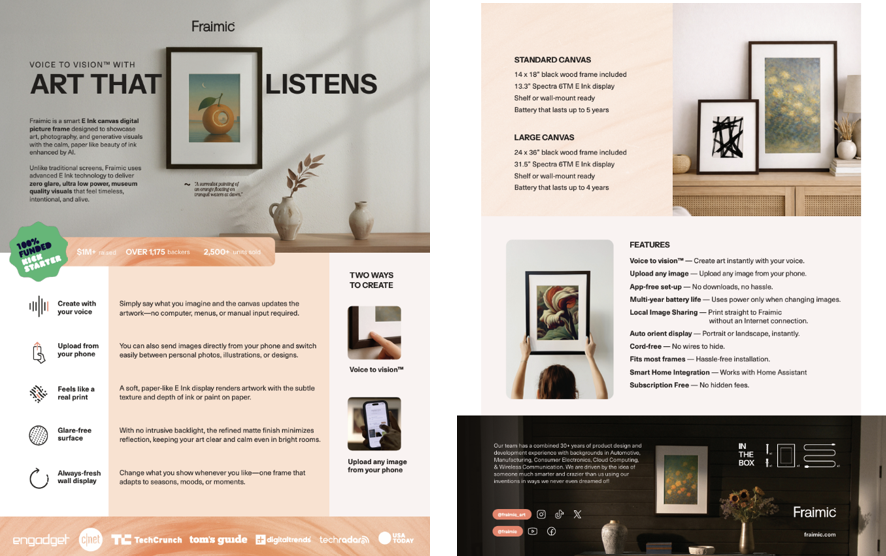
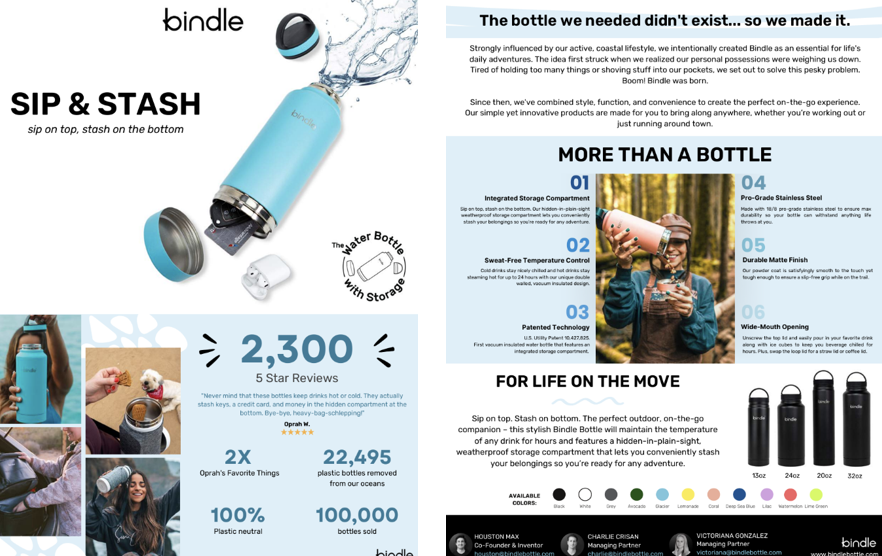
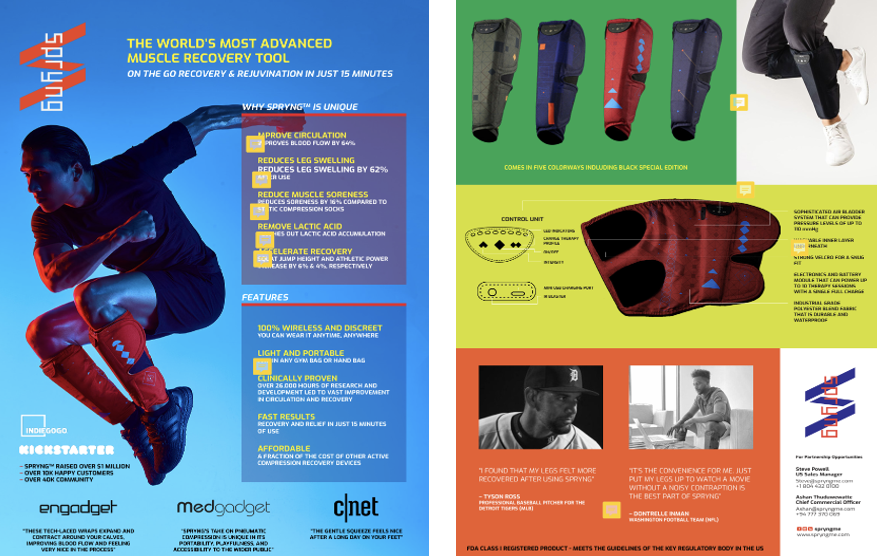
Product Sales Sheet Examples
Best Design Practices for Retail Product Sell Sheets
A professional sell sheet should be visually appealing without becoming cluttered or overwhelming.
The goal is readability and quick information processing.
Retail Product Sell Sheet Layout – Keep it Simple
Retail buyers often scan a sell sheet in seconds, so your layout should make the most important information easy to find. Avoid filling the page with long paragraphs or too many design elements. Instead, organize the information into clearly defined sections that guide the buyer naturally from your product and value proposition to pricing, retail details, and your call to action.
Use:
- Short, concise paragraphs that are easy to scan
- Bullet points for key product benefits and selling features
- Bold headers to clearly separate sections
- Consistent alignment for a professional, organized appearance
- Logical sections that prioritize the most important information
- Clear visual hierarchy so buyers know where to look first
Think of your sell sheet as a sales tool, not a brochure. Every element should serve a purpose and help the retail buyer quickly understand why your product belongs in their assortment. A clean, well-organized layout makes your brand appear more professional and makes it easier for buyers to evaluate your product and take the next step.
Use Visual Hierarchy
Prioritize information placement strategically.
Place the following near the top:
- Brand logo
- Product image
- Product name
- Key value proposition
Important information should be visible without excessive reading.
Use White Space Effectively
Do not overcrowd the page.
White space improves readability and makes important information stand out.
A cluttered sell sheet can appear unprofessional and difficult to review quickly.
Maintain Brand Consistency
Your sell sheet should visually align with:
- Product packaging
- Website design
- Brand colors
- Marketing materials
Consistent branding builds trust and reinforces professionalism.
Use Easy-to-Read Fonts
Choose clean, modern fonts that are easy to scan.
Avoid:
- Decorative fonts
- Overly small text
- Excessive italics
Remember: buyers review documents quickly, often on screens or mobile devices.
Sell Sheet Size, File Format, and How to Send it
Three specification questions come up constantly and the answers are short, so here they are.
Page size and orientation. Build it for US Letter in portrait if your buyers are in North America, because that is what prints from a buyer’s office printer without scaling or clipping. A sheet laid out for a different paper size loses its edges when printed, and a buyer who prints your sheet is a buyer who is taking it into a meeting.
One page or two. One is the default and the reason it is called a sell sheet. A second page is justified when you have a genuine product range with multiple SKUs that each need their own data line, or when the specification block cannot fit alongside the selling content without becoming unreadable. Never use a second page for more marketing copy.
File format. Send a flattened PDF. Design files and editable formats substitute fonts on a machine that does not have yours, which turns a careful layout into a mess on the one screen you cannot see. Flattening also stops anything reflowing. Keep the file small enough to pass through a corporate email gateway, which usually means compressing your images rather than sending print resolution originals.
Delivery matters as much as the file. Name it so it makes sense sitting on a stranger’s desktop next to dozens of others, with your brand name and the product in the filename rather than sellsheet final v3. Attach it rather than linking to it, because links break, expire and get blocked, and a buyer will not create an account to see your pricing. And never paste the sheet into the email body as an image. Sell sheets get forwarded to the category team, and an image in an email body does not survive the forward in any usable form.
Retail Product Sell Sheet Template
Product brands don’t need expensive graphic design software to create a professional retail sell sheet. You can build your layout using free tools and professionally designed templates from Canva Sell Sheet Templates or Adobe Express Sell Sheet Templates. These templates provide a strong starting point for organizing your product images, benefits, features, retail pricing, and company information.
When using a template, focus on customizing it to your product and the needs of retail buyers rather than simply filling in the blanks. Remove unnecessary design elements, use your own branding and product photography, and make sure the finished sell sheet clearly communicates your product’s retail value proposition and why a buyer should consider adding it to their assortment.
The template is a starting point, not the deliverable. Every field on it is there because a buyer somewhere asked for it, but the order and emphasis should change for the retailer being pitched. Fill it once fully, then cut for each submission rather than building a new sheet each time.
Common Retail Product Sell Sheet Mistakes to Avoid
Many brands lose retail opportunities because their sell sheets contain avoidable mistakes.
Here are some of the most common issues:
Too Much Text
Keep messaging concise and skimmable.
Missing Pricing Information
Buyers need immediate pricing visibility.
Poor Product Photography
Low-quality images damage credibility.
No Clear Call-to-Action
Tell buyers exactly what to do next.
Pro Tip: Make the call to action a next step the buyer can take without a meeting. A line offering samples with a stated turnaround, or a link to a shared folder with the spec sheet and case dimensions, gets acted on. “Contact us to learn more” asks the buyer to create work for themselves.
Generic Messaging
Tailor your sell sheet to the retailer whenever possible.
Lack of Retail Readiness Information
Operational preparedness matters just as much as branding.
Include a Strong Call-to-Action (CTA)
Every sell sheet should end with a clear next step.
Examples include:
- “Contact us to request samples”
- “Schedule a line review today”
- “Visit our wholesale portal”
- “Now accepting new retail partners”
You can also create urgency with limited-time incentives such as:
- Introductory wholesale pricing
- Free shipping on opening orders
- Promotional launch support
A strong CTA helps move conversations forward.
Final Thoughts: Your Retail Product Sell Sheet Is a Retail Sales Tool
Getting into retail requires more than a great product. Buyers want to work with brands that understand retail expectations and present themselves professionally.
Your sell sheet plays a major role in shaping that perception.
A strong retail sell sheet should:
- Capture attention quickly
- Highlight consumer demand
- Communicate profitability
- Demonstrate operational readiness
- Make it easy for buyers to move forward
When built correctly, a sell sheet becomes far more than a one-page document—it becomes a powerful retail sales asset that helps your brand stand out in a highly competitive marketplace.
Need Help Getting Retail-Ready?
At Retailbound, we help emerging and established brands successfully launch and scale within major retail channels across the United States and Canada.
From retail strategy and buyer outreach to sell sheet development and retail sales management, our team helps brands bridge the gap between product innovation and retail success.
If you’re ready to bring your product into major retailers but need help navigating the process, Retailbound can guide you every step of the way. Schedule a free consultation with one of our retail experts and discover how to get your product retail-ready, connect with the right buyers, and drive long-term retail growth.
Frequently Asked Questions
What should be included in a sell sheet?
One strong product image, a one-line unique selling proposition, the full retail data block covering UPC, case pack, dimensions, wholesale and suggested retail pricing, margin, minimum order quantity and lead time, proof that the product sells, and a single clear next step with contact details.
What size should a sell sheet be?
One page, at standard letter size for North American buyers, sent as a flattened PDF. Go to a second page only when the retail data block genuinely does not fit, and keep the file small enough to clear an email gateway without being compressed.
How to create a sell sheet?
Start from what the buyer needs to decide, not from a design. Gather the product data first, write the one-line proposition, choose two images, lay it out in the buyer’s reading order, then check it against the common mistakes before sending.
What does a sell sheet look like?
A single page with a product image and brand mark at the top, a short proposition line, a specification block of pricing and logistics data, a strip of retail proof, and contact details with one clear next step. The examples in this guide show the layout in use.
How do I sell my products to retail stores?
The sell sheet is one piece of it. You also need retail-ready packaging, costing that survives wholesale margin, a supply plan you can hold to, and a route to the right buyer for the category. The sell sheet is what gets you the conversation, not what closes it.
What is a product sheet?
A product sheet, or spec sheet, documents what the product is in technical detail. A sell sheet is a sales document that uses some of the same data to make a buying case. Buyers often ask for both, and sending the spec sheet when they wanted a sell sheet reads as not knowing the difference.
About the Author
Yohan Jacob is the President and Founder of Retailbound. Retailbound is a full-service retail channel management consultancy that helps brands launch and scale products across more than 150 retailers throughout the United States and Canada.
Retailbound specializes in retail strategy development, buyer engagement, sales management, retail marketing support, and channel expansion services for startups and established consumer brands.