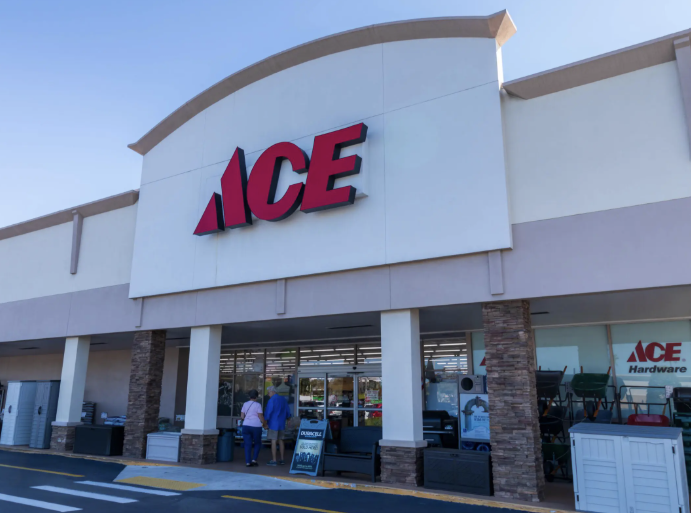
Getting your product into Ace Hardware can be a significant growth opportunity for brands in hardware, home improvement, lawn and garden, outdoor living, sporting goods, tools, automotive, paint, and related categories.
Ace Hardware is different from traditional big-box retailers because it operates as a cooperative made up of locally owned and operated stores. That creates opportunities for brands that can demonstrate strong product-market fit, retail readiness, and the ability to support both Ace’s merchandising organization and its independent retailers.
In 2026, Ace continues to expand its retail footprint and is on pace to open more than 170 new stores during the year. The company operates nearly 5,300 Ace stores across all 50 states, creating substantial potential for brands that can successfully navigate the Ace vendor process.
However, getting your product into Ace Hardware is competitive. Having a great product is only the beginning. You need the right retail pricing, margins, packaging, sales materials, inventory, logistics, and marketing support. Most importantly, you need to demonstrate why your product deserves a place in the Ace assortment.
In this 2026 vendor guide, we’ll walk you through how to get your product into Ace Hardware — from researching the market and preparing your brand to submitting your vendor application, developing your buyer pitch, understanding distribution, and building a long-term retail program.
Key Takeaways
- Ace Hardware operates nearly 5,300 stores across all 50 states and is on pace to open more than 170 more in 2026, so shelf space is genuinely expanding.
- Ace Hardware is a cooperative, not a chain. A corporate yes is permission to sell to independent owners, not an order for every store.
- The vendor application is the easy part. Most products fail on retail readiness, margin structure and timing against the category review window.
- Prepare answers to five buyer questions before you submit: what it is, who buys it, why it is different, why Ace Hardware, and why now.
- Plan for the first order to be small and regional. Ace Hardware rewards brands that support independent retailers, not just the co-op.
Want Help Getting Your Product into Ace Hardware?
Talk with a retail expert about your product and retail strategy.
Are You Looking to Supply Ace Hardware, or to own An Ace Hardware Store?
This guide is for brands that want Ace to stock their product: a vendor application, a buyer, a purchase order and a place on the shelf. If what you are actually researching is opening an Ace store or converting an existing hardware store to the Ace brand, that runs through Ace’s retailer side, and their own become-a-retailer information is the right place to start.
1. Research Ace Hardware and Your Product Category
Before approaching Ace Hardware, research the retailer and understand where your product fits within its assortment.
Start by visiting Ace Hardware stores and browsing AceHardware.com. Look at the brands, products, price points, packaging, product features, and merchandising strategies within your category.
Ask yourself:
- Does Ace already sell products similar to yours?
- How is your product different from competing products?
- What customer problem does your product solve?
- Is your price competitive with products already sold at Ace?
- Does your product fit the needs of Ace’s typically project-oriented customers?
- Could your product generate incremental sales rather than simply replace an existing item?
This research is critical because Ace buyers need to understand where your product fits within the existing assortment.
You should also research whether your product is better suited for a broad Ace rollout, a regional opportunity, a specific store group, or an online-only program.
2. Determine If Your Product Is a Good Fit for Ace Hardware
Ace Hardware carries a wide range of products across hardware, paint, lawn and garden, outdoor living, tools, home improvement, automotive, electrical, plumbing, cleaning, sporting goods, and other categories.
However, not every product is a natural fit.
Ace tends to be particularly relevant for products that help customers complete a project, solve a problem, maintain their home, improve their yard, or make everyday tasks easier.
Before contacting Ace, make sure you can clearly explain:
- Who is the target Ace customer?
- What problem does your product solve?
- Why should Ace carry your product?
- What makes your product different?
- What retail price point makes sense?
- What competitive products are currently available?
- What evidence demonstrates consumer demand?
If your product is already selling successfully through your own website, Amazon, specialty retailers, or other retail channels, use that data to strengthen your case.
Sales history, customer reviews, repeat purchases, retailer performance, media coverage, and other forms of consumer validation can help demonstrate that your product has potential beyond your existing sales channels.
3. Make Sure Your Brand Is Retail-Ready
Before you approach an Ace Hardware buyer, make sure your company is prepared to operate as a retail vendor.
Ace has specific vendor requirements and provides domestic and import vendor manuals for prospective suppliers. You should review the applicable requirements before submitting your product for consideration.
Your retail-readiness checklist should include:
- Professional retail packaging
- UPC/GTIN barcodes
- Competitive wholesale and retail pricing
- Healthy retailer margins
- Product specifications
- Product dimensions and weights
- Case-pack information
- Minimum order quantities
- Shipping information
- Product photography
- Product sell sheets
- Installation or instructional materials, when applicable
- Safety and compliance documentation
- Product certifications, when required
- Liability insurance
- Inventory and production capabilities
- Retail marketing support
- Customer service and warranty information
If your product is imported, you should also make sure your company is prepared to meet Ace’s import requirements and related compliance procedures.
The goal is simple: when a buyer shows interest, you should be ready to move forward rather than spending months getting your business operationally prepared.
Pro Tip: Before you submit anything, put your product on a shelf next to the two competitors Ace already stocks and photograph it from six feet away. If a shopper cannot tell what it does in two seconds, the packaging is the reason you will be passed over, not the product. Buyers make this judgment in the room, from the same distance.
4. Submit Your Product Through Ace Hardware’s Vendor Portal
Ace Hardware provides a dedicated “Become a Vendor” portal for companies interested in supplying Ace.
The first step is to submit the vendor application and make sure you meet Ace’s minimum requirements.
However, submitting an application does not guarantee that you will receive a response.
Ace states that new vendor requests are reviewed by its merchandising department and that, because of the volume of requests it receives, Ace will only contact vendors it decides to pursue.
That makes the quality of your initial submission extremely important.
Don’t treat the application as simply a form to complete. Your submission should clearly communicate:
- What your product is
- Why it is different
- Who buys it
- Why it belongs at Ace
- Your current sales performance
- Your retail experience
- Your competitive advantage
- Your wholesale pricing
- Your suggested retail price
- Your marketing strategy
- Your ability to support a retail rollout
A buyer should be able to understand the opportunity quickly without having to search through your website or request basic information.
5. How Long the Ace Hardware Vendor Process Actually Takes
The question everybody asks after hitting submit is how long this takes, and nobody publishes an answer because the honest one is that it depends on where your category sits in the review calendar. What can be described accurately is the sequence, what governs the wait at each stage, and which stages stall. Use it to plan your cash and your production, not to set a countdown.
Two things matter more than any single duration. First, the review calendar drives everything. Categories are reviewed on a cycle, and a submission that arrives just after a review closes waits for the next one no matter how good it is. Second, silence in the early stages is normal, because Ace’s merchandising department reviews new vendor requests and contacts only the vendors it decides to pursue. An absence of response is not the same as a decision.
| Stage | What is happening | What determines how long it takes | Where it stalls |
| Submission to acknowledgment | Your vendor application enters the merchandising review queue | Submission volume in your category and whether your application is complete enough to route | Incomplete submissions that cannot be routed to a category owner sit unassigned |
| Acknowledgment to buyer review | A category buyer looks at the opportunity against the current assortment | Where the category sits in its own planning cycle and how much of the assortment is already committed | A buyer mid-reset will not open new submissions until the reset ships |
| Buyer review to a category review window | Your product is held for the next scheduled review of that assortment | The category’s review cadence and the seasonal calendar attached to it | This is the longest wait in the process and the one most brands are unprepared for |
| Category review to a decision | Your product is compared against other submissions and against what is already on shelf | Whether your submission answers what gets removed to make room for you | Submissions with no delist argument lose to ones that have it |
| Decision to vendor setup | Vendor forms, insurance, product data, EDI, logistics and compliance setup | Entirely within your control, and directly proportional to how retail-ready you already were | Brands that treated readiness as a later problem lose weeks here |
| Setup to shelf | First purchase order, production, shipment to distribution, store placement | Your production lead time and the retailer’s delivery windows | Lead times quoted by a factory that has never shipped a retail volume order |
The practical read: everything before a decision is governed by the retailer’s calendar, and everything after it is governed by yours. You can only compress the second half, which is a strong argument for being fully retail-ready before you submit rather than after.
6. Develop a Strong Pitch for the Ace Buyer
Once you have identified the appropriate Ace merchandising contact, your product pitch needs to be concise and retailer-focused.
Don’t simply explain why you love your product.
Explain why Ace should care.
A strong Ace Hardware buyer presentation should answer five basic questions:
What is the product?
Explain the product in simple terms and demonstrate how it works.
Who is the customer?
Identify the specific consumer or user who is most likely to purchase it.
Why is it different?
Explain your competitive advantage and what makes the product stand out from the existing assortment.
Why Ace?
Show that you understand Ace’s customer, merchandising strategy, and product assortment.
Why now?
Provide evidence that the category or product is generating consumer demand.
Whenever possible, support your presentation with data.
For example:
- Annual sales
- Monthly sales growth
- Amazon sales
- DTC sales
- Retail sales
- Number of units sold
- Average customer rating
- Number of reviews
- Repeat purchase rate
- Social media traction
- Media coverage
- Other retailer performance
A polished presentation backed by actual sales data is much more compelling than a presentation based primarily on product features.
Pro Tip: Answer “why now” with the buyer’s calendar, not yours. Tie your pitch to a category review window, a season Ace is already merchandising for, or a gap left by a discontinued line. “We are ready” is not a reason for a buyer to act this quarter.
7. Why Ace Hardware Turns Down Products That Are a Good Fit
Plenty of good products that fit Ace’s customer perfectly still get passed over, and it is rarely about quality. These are the things the buyer is weighing that have nothing to do with whether the product works.
The packaging is not built for a hardware shelf. A product that arrives in a plain carton or an ecommerce mailer cannot be merchandised, cannot hang, and does not explain itself to a shopper walking an aisle. The buyer is not judging your taste. They are judging whether the pack can sell without an associate standing next to it, and whether it fits the fixture the category already uses.
The margin does not survive the structure. A price that works when you sell direct often collapses once a co-op and a distribution step are both taking their share. The buyer runs your wholesale price through the full chain to a shelf price that has to sit competitively next to products already in the aisle. If nothing is left, the review ends there, regardless of how strong the product is.
There is no plan for the independent retailer who orders small. Ace stores are locally owned and order in quantities that suit a single store, not a national rollout. A case pack sized for a big-box distribution center, or a minimum order quantity an individual retailer cannot justify, makes the product impractical for the stores that would actually stock it.
It arrived outside the review window. Categories are reviewed on a cycle. A submission that lands after the assortment is set for the coming season is not being rejected, it is being deferred, but a brand that never follows up experiences it as a no.
There is no answer to what this replaces. Shelf space is finite, so every addition removes something. The buyer has to defend that trade internally. A submission that explains which underperforming item it displaces, and why the category is better off after the swap, has done the buyer’s argument for them. One that simply asks for space leaves that work undone.
The company cannot support the stores after the first order. Product education, replenishment, in-store support and a responsive contact matter more in a co-op than in a chain, because the people selling your product are independent operators making their own reorder decisions. A buyer who doubts you can support them will not list you.
8. Understand That Ace Hardware Is a Cooperative
The cooperative model changes three practical things: who makes the decision, how orders reach you, and who you have to keep selling to after the first one. A brand that plans its Ace program the way it would plan a big-box program tends to get the first part right and the rest wrong. Approval by central merchandising is permission to be bought, not a guarantee that stores will buy. The selling job continues at store level, for as long as you want the product on shelf.
That is also the opportunity. A single chain buyer is one door that is either open or shut. A co-op gives you several routes in, and a product that proves itself with a group of independent retailers builds exactly the kind of evidence central merchandising responds to.
| Ace Hardware | A traditional big-box retailer | |
| Who decides | Central merchandising sets the assortment, and individual owners decide what their store stocks | One buyer’s decision applies to the whole |
| What approval means | Your product becomes available to stores, which then choose it or do not | Your product is placed in the stores the plan specifies |
| How orders arrive | Many smaller orders, at different times, from independently owned stores | Large consolidated orders on the chain’s replenishment cycle |
| Rollout shape | Grows store by store and region by region as owners adopt it | Arrives all at once in the store count the buyer assigned |
| Who you keep selling to | | Central merchandising and the store owners, continuously | The buyer, at each category review |
| Assortment variation | | Varies by store, based on local market, store size and category needs | Set centrally and largely uniform |
| What drives reorders | An owner seeing the product turn in their own store | Sell-through data reviewed centrally |
| What support looks like | Product education and merchandising help aimed at individual retailers | Programs negotiated centrally and executed chain-wide |
Plan for the shape on the left. It is slower to reach full distribution and considerably more forgiving of a brand still learning, because you are not betting the company on one order.
9. Consider Distribution Through Ace’s Network
Distribution is an important part of your Ace Hardware strategy.
Ace operates an extensive network of retail support centers and distribution capabilities designed to support its stores. Ace also owns Emery Jensen Distribution, a national hardlines wholesaler serving independent hardware and other retailers.
For some brands, working through the appropriate distribution channel may provide additional opportunities beyond a direct Ace retail program.
However, don’t assume that finding a distributor is a substitute for getting the attention of the right Ace merchandising team.
Distributors generally want products that already demonstrate demand and have a clear path to sales. Your goal should be to develop a distribution strategy that complements your retail strategy.
Before approaching a distributor, understand:
- Your wholesale price
- Distributor margin
- Retailer margin
- Suggested retail price
- Freight costs
- Minimum order quantities
- Case packs
- Lead times
- Inventory requirements
- Marketing support
You need to make sure the economics work for every participant in the channel.
Pro Tip: Work out your margin at the Ace warehouse price, not your usual wholesale price, before you quote anything. Brands routinely discover after a yes that the co-op and distribution structure leaves them nothing per unit, and repricing after a purchase order is far harder than pricing correctly before one.
10. Build Your Ace Hardware Retail Strategy
Getting approved as a vendor is only the beginning.
Once your product is accepted, you need a strategy for generating sell-through and repeat orders.
This is where many brands make a mistake.
They focus entirely on getting the initial purchase order instead of thinking about what happens afterward.
Your Ace retail strategy should address:
- Initial store placement
- Product assortment
- Inventory levels
- In-store merchandising
- Product education
- Retailer training
- Promotions
- Digital marketing
- Seasonal opportunities
- New product launches
- Store expansion
- Reorders and repeat purchase orders
Ace’s locally owned store model also creates opportunities to learn from individual retailers.
If certain stores perform significantly better than others, analyze why. Those insights can help you refine your broader Ace strategy.
11. Support Your Product with Retail Marketing
A buyer doesn’t just want to know that your product can sell.
They want to know how you plan to help it sell.
Develop a marketing plan before approaching Ace.
Your plan might include:
- Social media advertising
- Google advertising
- Influencer marketing
- Retailer-specific promotions
- Email marketing
- Demonstration videos
- Product education
- In-store demonstrations
- Seasonal campaigns
- Public relations
- Digital content
- Retail media
Ace has also continued to expand opportunities for vendors to reach Ace retailers through retail-facing media and educational content.
If you can demonstrate that you are prepared to invest in building consumer demand, you can make a stronger case that your product can generate sell-through rather than simply an initial sell-in.
12. Follow Up and Build the Buyer Relationship
If you don’t receive an immediate response from Ace, don’t assume that your product has been permanently rejected.
Retail buyers receive a tremendous number of product submissions, and buying decisions are influenced by category plans, seasonal calendars, inventory, product launches, and other business priorities.
Follow up professionally and provide meaningful new information when possible.
For example:
- New sales results
- New retailer placements
- Increased customer reviews
- Product improvements
- New certifications
- New marketing initiatives
- Strong seasonal performance
- New product extensions
Avoid sending repetitive emails that simply ask, “Did you have a chance to review my product?”
Instead, give the buyer a reason to reconsider the opportunity.
13. Be Prepared for Ace’s Vendor Requirements
Once Ace decides to move forward with a new supplier, expect additional operational and compliance requirements before your products can begin shipping.
Depending on your situation, this can include vendor forms, insurance documentation, product information, logistics requirements, electronic data interchange (EDI), shipping requirements, and other operational setup.
Ace’s vendor systems and manuals provide detailed requirements for suppliers.
This is another reason why retail readiness matters.
A brand that has never worked with a major retailer may underestimate the amount of operational work required after the buyer says “yes.”
Getting the purchase order is not the finish line.
It is the beginning of your retail relationship.
Conclusion
Getting your product into Ace Hardware can be an excellent opportunity for brands in hardware, home improvement, lawn and garden, outdoor, tools, sporting goods, and other complementary categories.
But success requires more than submitting a vendor application.
You need to:
- Research Ace Hardware and your category.
- Determine whether your product is a strong fit.
- Make your company retail-ready.
- Submit a professional vendor application.
- Develop a compelling buyer presentation.
- Understand Ace’s cooperative retail model.
- Develop the right distribution strategy.
- Create a plan for sell-through and repeat orders.
- Support your product with retail marketing.
- Build and maintain relationships with Ace buyers and retailers.
The most important thing to remember is that getting into Ace Hardware is only the first step. The real goal is generating strong sell-through, repeat purchase orders, and long-term retail growth.
If you’re serious about getting your product into Ace Hardware or other major U.S. retailers but aren’t sure where to start, Retailbound can help.
Since 2008, Retailbound has helped product brands launch and grow in major retailers across the United States and Canada. Our team includes former retail buyers and retail industry professionals who understand what it takes to get a product retail-ready, develop a compelling buyer pitch, connect with the right retail channels, and build a sustainable retail sales program.
Ready to take your product into retail? Schedule a free consultation with Retailbound to discuss your retail strategy and determine whether your product is ready for Ace Hardware and other major retailers.
Frequently Asked Questions
How to get a product into Ace Hardware?
Submit through Ace’s vendor portal with retail-ready packaging, costing that works at warehouse pricing, and a pitch aimed at a specific category. Approval from Ace’s merchandising team makes the product available to order; individual store owners then decide whether to stock it.
How to become a supplier for Ace Hardware?
Becoming a supplier means clearing three things in order: a product that fits a category Ace already merchandises, a business that can meet vendor requirements such as insurance, barcoding and fulfillment, and a submission timed to the category review window.
Does Ace Hardware do business accounts?
Ace serves commercial and trade customers through its stores, which matters to a vendor because a product with professional or contractor appeal can be sold into that channel as well as to retail shoppers.
Do I need a distributor to sell to Ace Hardware?
Not always. Products can move through Ace’s own distribution network or ship direct depending on the category and volume. The choice changes your margin and your minimum order, so work it out before you quote.
What does Ace Hardware require from new vendors?
Expect requirements covering liability insurance, UPC and barcoding, packaging and labeling standards, fulfillment and lead times, and compliance paperwork for the category. Gather these before applying; they are the most common cause of a stalled submission.
About the Author
Yohan Jacob is the President and Founder of Retailbound, a full-service retail channel management agency that helps product brands launch and grow in major retailers across North America. With more than 30 years of retail experience, Yohan and his team specialize in retail strategy, buyer engagement, channel marketing, and sales management to help brands increase their retail presence both in-store and online.