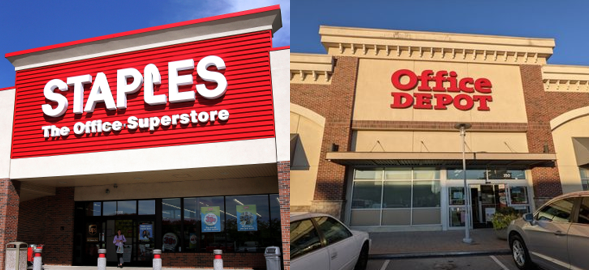
If you’re a product manufacturer looking to grow beyond DTC sales and online marketplaces, selling to major office supply retailers like Staples or Office Depot can be a significant growth opportunity. Both retailers offer product brands access to a large customer base through brick-and-mortar stores and ecommerce, while also providing the credibility that comes with being carried by a nationally recognized retailer.
However, getting a product approved by Staples or Office Depot requires more than having a great product. Retail buyers are looking for brands that are retail-ready, competitively priced, operationally capable, and able to demonstrate a clear customer need and compelling reason for the retailer to carry the product. Your packaging, wholesale pricing, margins, sales history, marketing support, inventory capabilities, and buyer presentation can all influence the decision.
In this guide, we’ll walk you through the key steps to selling your product to Staples or Office Depot, including how to determine whether your product is a good fit, prepare your brand for retail, approach the right buyer, and build a compelling pitch that gets your product considered. Or, listen to our latest podcast on this very subject.
Key Takeaways
- Staples and Office Depot both separate merchandise supply from corporate procurement, and searching the general supplier terms lands most brands in the procurement system.
- Office Depot operates under the ODP Group, so supplier material appears under both names and covers more than retail merchandising.
- Vendor compliance is a real cost line at these retailers. Routing, labeling, item data and sourcing documentation all carry consequences.
- Retail agreements here commonly include payment terms such as Net 60 or Net 90, chargebacks for shipping errors, marketing allowances and promotional commitments, so margin has to be modeled after all of them.
- A purchase order at national scale can run to tens of thousands of units, so confirm your manufacturer and your third party logistics provider can hold that before you pitch.
- The store shelf is only one channel. The business and contract side asks for different things and is often the larger opportunity.
Want Help Getting Your Product into Staples or Office Depot?
Talk with a retail expert about your product and retail strategy.
Step 1: Conduct Market Research and Confirm Product Fit
Before contacting a buyer, validate that your product belongs in their assortment.
Visit a local Staples or Office Depot store and study:
- The aisle your product would live in
- Competing brands
- Retail pricing
- Packaging design
- Shelf positioning
Ask yourself:
- Does my product solve a problem better than existing options?
- Is there a gap in the assortment?
- Does my product align with retailer trends (eco-friendly, work-from-home, tech innovation, productivity tools)?
- Can I offer a competitive wholesale price while protecting my margins?
Retail buyers are not looking for “another version” of an existing item. They want differentiation, innovation, and strong margin potential.
Pro Tip: Walk the store and count the private label facings in your category before you build the deck. If the retailer’s own brand already owns the value position in that section, your pitch has to be a premium or a technology argument, not a price one, and knowing that before the meeting changes every slide in the deck.
Step 2: Make Your Product Retail-Ready
Retail packaging is not the same as DTC packaging.
Your packaging must:
- Include a scannable UPC barcode
- Follow labeling compliance standards
- Be durable for shipping and store handling
- Fit standard shelving or peg hooks
- Clearly communicate benefits from five feet away
In retail, your packaging is your silent salesperson. It must:
- Stop the shopper
- Explain value quickly
- Drive impulse conversion
A sleek Instagram-style box won’t work if it doesn’t clearly state what the product does.
Step 3: Build a Data-Driven Retail Pitch Deck
When pitching Staples or Office Depot buyers, you are not pitching a product — you are pitching a business case.
Your pitch must immediately answer:
- Why this product? (Differentiation)
- Why now? (Market trends & demand)
- How will it sell? (Marketing & sell-through strategy)
Include:
- Sales data (Amazon, Shopify, Kickstarter, etc.)
- Revenue growth trends
- Customer reviews and ratings
- Target margin structure
- Marketing commitments
- Supply chain readiness
Buyers care about:
- Gross margin
- Inventory turnover
- Velocity
- Marketing support
- Risk mitigation
If you cannot show proof of demand, your pitch becomes much harder.
Why Office Superstore Buyers Pass on Products that Sell Well Online
Plenty of rejections have nothing to do with how good the product is or how well it sells online. These are the ones that come up most often, and each is something the buyer weighs against your item without necessarily saying so out loud.
The category is being shrunk in-store. Office superstores have been reallocating floor space for years, and some categories are deliberately being reduced in the aisle while continuing to grow on the website. If yours is one of them, a great pitch into a shrinking fixture still loses, and the right ask may be an online listing rather than a shelf.
It competes with private label. Both retailers carry substantial own-brand ranges, and own brand earns better margin than you do. A buyer weighing your item against their own label needs a reason that survives that math, usually a feature or a price tier the private label does not cover.
The margin does not survive the structure. Your quoted margin is a starting point. Freight, allowances, promotional commitments and chargebacks all come off it. Buyers model the fully loaded number, and a brand that only knows its headline margin gets exposed in the first detailed conversation.
No answer to what comes off the shelf. Space is fixed. Adding you means removing something, and if you have not proposed what that is, the buyer has to do it for you, which is work done in favor of the item you did not think about.
The pack format is built for a marketplace, not a fixture. A pack designed for a parcel and a product page often does not hang, does not stack, wastes facing width or fails to explain itself from a few feet away. This is a common and entirely avoidable no.
No capability on the business and contract side. A great deal of these retailers’ volume runs through business, contract and education accounts. If you cannot support that channel, with the pricing, catalog data and documentation it requires, you are pitching for a fraction of the opportunity and the buyer knows it.
None of these are about product quality. All of them are answerable before the meeting, and a brand that raises two or three of them itself, with a proposal attached, reads very differently from one that waits to be asked.
Step 4: Connect with the Right Buyer or Category Manager
Cold emails to general inboxes rarely work.
Instead:
- Identify the correct category manager or merchant on LinkedIn
- Attend trade shows like CES or the National Hardware Show
- Use product discovery platforms like RangeMe
- Consider hiring a retail broker or retail consultant
Retail product launch agencies like Retailbound often have established relationships that significantly accelerate buyer access.
Access matters in retail.
Merchandise Supplier, Procurement Vendor or Diversity Registration
Search either retailer as a supplier and you land in three different systems that look similar and lead to completely different places. Brands lose months in the wrong one. A responsible sourcing manual and a supplier diversity form both feel like progress, and neither of them puts your product in front of the person who decides what the stores sell.
Figure out which door you are knocking on before you fill anything out.
| Merchandise supplier | Procurement and indirect sourcing | Supplier diversity registration | |
| What you are selling | A product the retailer sells to customers | Goods and services the business uses | Either, once qualified |
| Who decides | Category buyer and merchandising | Corporate procurement | A qualification team, not a buyer |
| Typical entry point | The supplier portal plus a buyer conversation | The supplier program and sourcing documentation | A diversity registration portal |
| What the paperwork asks for | Product data, pricing, compliance | Responsible sourcing and transparency documentation | Certification and ownership evidence |
| Covered in this guide | Yes | No | As a supporting step only |
The third one is worth being blunt about. Registering as a diverse supplier is worth doing if you qualify, and it is a qualification layer rather than a route in. It records who you are. It does not put an item into a category review, and a brand that registers and waits is a brand that waited.
The procurement material matters to merchandise suppliers too, just not as an entry point. Read it once you are in a buying conversation, because the standards in it will apply to you. Do not mistake it for the front door.
Pro Tip: Ask at first contact which channel you are being considered for. Retail shelf, dot com, and the business and contract catalog are separate decisions with separate requirements, and a brand that assumes it is pitching for shelf space will bring the wrong evidence to a contract channel conversation. One question saves a wasted meeting.
Step 5: Understand the Vendor Submission Process
Once you get a buyer’s attention, expect a structured review process.
You may need to provide:
- Wholesale pricing
- Minimum order quantities (MOQs)
- Product specs
- Case pack details
- Insurance certificates
- Financial information
- Operational capabilities
You will likely be asked to submit production-quality samples.
Retail line reviews can take months. Persistence and professional follow-up are critical.
Staples Supplier Portal
Product brands interested in becoming a Staples supplier can submit their company and product information through the official Staples Exchange platform. Staples Exchange allows prospective vendors to apply for consideration and, once approved, manage products, orders, pricing, inventory and other vendor activities through the platform.
OfficeDepot Supplier Portal
Office Depot does not currently appear to offer a general public supplier portal for all prospective vendors. Brands interested in submitting a product for resale through Office Depot’s retail stores, online channels or contract business should review the Office Depot Vendor Development information and follow the submission instructions for Vendor Development; Office Depot specifically directs prospective suppliers with products for resale to this process.
Registering on a supplier portal qualifies your company. It does not put your product in front of a category buyer. Treat the portal as the step that removes an excuse for not looking at your submission, then do the work of identifying the right buyer and giving them a reason to open it.
Step 6: Negotiate Retail Terms Carefully
If a buyer expresses interest, congratulations — now comes the contract stage.
Retail agreements may include:
- Payment terms (Net 60 or Net 90)
- Chargebacks (penalties for shipping errors)
- Marketing allowances
- Returns policies
- Promotional commitments
Make sure your margins work after:
- Freight
- Allowances
- Chargebacks
- Promotional spend
If you cannot adjust price, negotiate:
- Smaller initial test orders
- Regional rollout
- Improved payment terms
Retail success starts with profitable agreements.
Vendor Compliance is a Cost Line, not a Checkbox
The terms you negotiated in the previous step are the top line. Compliance is where the margin quietly leaves. Each of these is a published standard with a specific trigger, and the cost of missing one comes off your invoice rather than arriving as a bill you can question first.
Routing and delivery window compliance. The retailer names the carrier, the lane and the booking process, and expects delivery inside a defined window at a defined facility. Route it yourself or arrive outside the window and the freight difference and the penalty both land on you.
Case and pallet labeling standards. Format, content and placement are specified down to where the label sits on the carton. A label the receiving scanner cannot read creates manual work at the distribution center, and that work is charged back to the vendor who caused it.
Electronic order and invoice exchange. Purchase orders, advance ship notices and invoices move as EDI documents. A late or mismatched notice causes receiving discrepancies, and discrepancies become shortage claims against your invoice whether or not the goods arrived.
Item setup and product data accuracy. Dimensions, case configuration, cost, barcodes, imagery and copy all sit in the retailer’s systems. Wrong data does not stay a data problem. It becomes a receiving exception, a pricing discrepancy or a listing nobody can find.
Packaging specifications. Pack format, protection, hanging or shelf presentation and pallet build are all specified, and these retailers merchandise on fixtures your pack either fits or does not.
Supplier principles and responsible sourcing documentation. Both retailers publish supplier conduct standards and expect suppliers to attest to them, covering labor practices, sourcing and supply chain transparency. This is paperwork with real deadlines, not a formality you sign at the end.
There is a reason this material runs deeper here than at a general merchandise retailer. Staples and Office Depot sell heavily into government, education and enterprise accounts, and those customers push their own contracting requirements up the chain. That is why federal contracting language and sourcing documentation show up in supplier material for what looks like an ordinary consumer retailer, and it is why your product’s country of origin and component sourcing can matter more in this relationship than in general retail. If you make anything with electronics or connectivity in it, get advice on that before you submit rather than after.
Ask for the current vendor compliance manual before you price the deal. It tells you what is triggered by what, and who absorbs it, which is the information you need to know whether the margin you agreed is the margin you keep.
Pro Tip: Build your margin model with a compliance line in it before you quote a price. Freight, allowances, promotional spend and chargebacks are all foreseeable, and a brand that discovers them after the purchase order is negotiating from the weakest position it will ever be in. If the number only works with zero chargebacks, the number does not work.
Step 7: Prepare Your Supply Chain for Scale
Can your operations handle a 5,000–20,000 unit purchase order?
Retailers expect:
- High fill rates
- On-time delivery
- Routing guide compliance
- Proper labeling and pallet configuration
If you fail to meet standards, you may face costly chargebacks.
Ensure:
- Your manufacturer can scale
- Your 3PL understands retail compliance
- Your inventory planning is strong
Operational excellence is non-negotiable at the national retail level.
Pro Tip: Get your third party logistics provider to confirm in writing that it can meet the retailer’s routing guide before you sign anything. Retail compliance is a specific capability, not a general competence, and a fulfillment partner that is excellent at ecommerce can be completely unprepared for a routing window, a pallet specification and an advance shipping notice.
Step 8: Drive Sell-Through with Marketing Support
Getting on the shelf is only half the battle. Sell-through determines whether you stay.
Retailers expect you to help drive demand.
Your marketing plan should include:
- Email marketing to your customer list
- Social media announcements
- Geo-targeted ads near store locations
- Influencer partnerships
- PR outreach
- In-store promotional support
Show buyers you are committed to long-term growth — not just landing the initial PO.
The In-store Shelf is not the Whole Opportunity
Brands pitch the store shelf and assume that is the account. It is one of four ways these retailers reach customers, and for some products it is neither the largest nor the easiest to enter.
The stores are the hardest door. Space is fixed, the assortment is narrow, and your pack has to work on the fixture. The websites carry far more items than any store can, with no shelf constraint, which makes an online listing a realistic first step and a legitimate thing to propose when a buyer has no room in the aisle. The business and contract channel serves companies, schools, government bodies and institutions through negotiated agreements and catalogs, and a great deal of an office supply retailer’s volume actually sits there. Marketplace and drop-ship arrangements let the retailer list your item without owning the inventory, which lowers their risk and changes what they need from you.
What each channel asks of you is different. The contract channel wants a catalog listing, agreed pricing, accurate product data and often the compliance documentation described above. It frequently does not care about your retail packaging at all, because the item ships in a box to an office. The store shelf wants a fixture-ready pack, a sell-through story and marketing support. A drop-ship arrangement wants clean data, reliable single-order fulfillment and tight service levels, which is closer to the direct business you may already be running than to pallet distribution.
So ask the question directly: which channel are you evaluating us for. It is a normal question, it makes you sound like somebody who understands the business, and the answer changes what you should be preparing. The channels to name:
- Retail stores
- The retailer’s ecommerce site
- The business, contract and education channel
- Marketplace and drop-ship programs
A brand that wins a contract catalog listing and grows from there has a real relationship with the retailer, revenue, and a track record to bring back to the merchant who said no to the shelf. That is a better position than waiting a full cycle for another shot at the aisle.
Four Channels, Four Different Asks
| Channel | What it needs from you | How performance is judged |
| Retail store shelf | Fixture-ready pack, retail pricing, sell-through evidence | Units per store per week |
| Retailer ecommerce | Strong product data, imagery, reviews, shipping-ready pack | Conversion and return rate |
| Business and contract | Catalog listing, agreed pricing, compliance documentation | Account penetration and repeat volume |
| Marketplace or drop-ship | Inventory feed, fulfillment speed, individual shipping | Fulfillment reliability |
Long-Term Success at Staples or Office Depot
The brands that thrive inside Staples and Office Depot:
- Monitor weekly sales performance
- Analyze sell-through data
- Proactively solve supply chain issues
- Continuously innovate
- Maintain strong buyer communication
Retail is not a one-time win — it’s an ongoing partnership.
Final Thoughts: Is Your Brand Retail-Ready?
Getting your product into Staples or Office Depot can transform your brand — but only if you are fully prepared for the operational, financial, and marketing demands of national retail.
If you’re ready to bring your product into major retailers but need help navigating the process, Retailbound can guide you every step of the way. Schedule a free consultation with one of our retail experts and discover how to get your product retail-ready, connect with the right buyers, and drive long-term retail growth.
Frequently Asked Questions
How do I get my products into stores?
The sequence is the same at most retailers. Confirm your product fits a category the store already merchandises, make the pack retail-ready, build a business case with rate of sale evidence, identify the category buyer rather than a general inbox, and register on the supplier portal so paperwork is not the reason you stall. The differences between retailers are in the requirements, not the order.
What are vendor compliance requirements?
They are the operating rules a supplier agrees to once an order is placed: how and when product ships, how cases and pallets are labeled, how orders and invoices are exchanged electronically, what product data has to be loaded and kept accurate, and what documentation the retailer needs about how the product is sourced. Missing any of them usually triggers a deduction.
What do you need to be a supplier?
At minimum, a registered business with liability insurance, properly barcoded product, the ability to exchange orders and invoices electronically, a fulfillment operation that can meet routing requirements, and pricing that survives freight, allowances and chargebacks. Office superstores also ask more sourcing and compliance questions than general retailers because of their government and enterprise accounts.
How does Office Depot support small businesses?
Office Depot and the wider ODP Group serve small businesses as customers through stores, ecommerce and a business account channel. For a brand the relevant point is the reverse one: that business and contract channel is a separate route to sell through, with its own catalog, pricing and compliance requirements, and it is worth asking a buyer which channel you are being considered for.
How do I become a Staples supplier?
Register your business through the supplier registration route, prepare compliance documentation and product data in advance, then work toward the category buyer who owns your section. Registration qualifies the company. A buyer still has to be given a reason to open the submission, which is what the pitch deck is for.
About the Author
Yohan Jacob is the President and Founder of Retailbound, a leading retail channel management consultancy helping brands launch and scale into 150+ retailers across the U.S. and Canada.
Retailbound specializes in:
- Retail strategy development
- Buyer engagement
- Sales management
- Channel marketing support
- Retail readiness preparation
Whether you’re a startup with traction or an established brand ready to expand, Retailbound bridges the gap between product innovation and retail success.