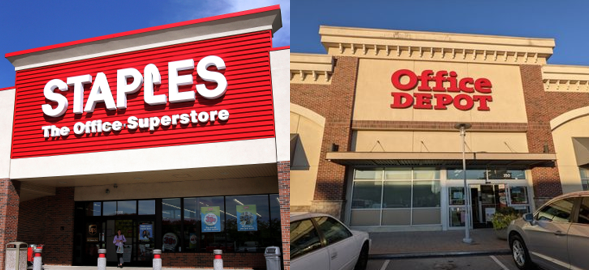
If you’re a product manufacturer looking to scale beyond DTC and online marketplaces, landing on the shelves of major office supply retailers like Staples or Office Depot can be a game-changing move.
Getting into Staples or Office Depot provides:
- National brand exposure
- Instant credibility
- Access to both brick-and-mortar and eCommerce distribution
- Large-volume purchase orders
But breaking into these retail giants requires far more than a great product. You need retail-ready packaging, competitive pricing, operational strength, and a compelling pitch built around buyer expectations.
This step-by-step guide explains exactly how to get your product into Staples or Office Depot — and what you must prepare before approaching a retail buyer.
Step 1: Conduct Market Research and Confirm Product Fit
Before contacting a buyer, validate that your product belongs in their assortment.
Visit a local Staples or Office Depot store and study:
- The aisle your product would live in
- Competing brands
- Retail pricing
- Packaging design
- Shelf positioning
Ask yourself:
- Does my product solve a problem better than existing options?
- Is there a gap in the assortment?
- Does my product align with retailer trends (eco-friendly, work-from-home, tech innovation, productivity tools)?
- Can I offer a competitive wholesale price while protecting my margins?
Retail buyers are not looking for “another version” of an existing item. They want differentiation, innovation, and strong margin potential.
Pro Tip: If the category is crowded, your USP (unique selling proposition) must be obvious within three seconds.
Step 2: Make Your Product Retail-Ready
Retail packaging is not the same as DTC packaging.
Your packaging must:
- Include a scannable UPC barcode
- Follow labeling compliance standards
- Be durable for shipping and store handling
- Fit standard shelving or peg hooks
- Clearly communicate benefits from five feet away
In retail, your packaging is your silent salesperson. It must:
- Stop the shopper
- Explain value quickly
- Drive impulse conversion
A sleek Instagram-style box won’t work if it doesn’t clearly state what the product does.
Step 3: Build a Data-Driven Retail Pitch Deck
When pitching Staples or Office Depot buyers, you are not pitching a product — you are pitching a business case.
Your pitch must immediately answer:
- Why this product? (Differentiation)
- Why now? (Market trends & demand)
- How will it sell? (Marketing & sell-through strategy)
Include:
- Sales data (Amazon, Shopify, Kickstarter, etc.)
- Revenue growth trends
- Customer reviews and ratings
- Target margin structure
- Marketing commitments
- Supply chain readiness
Buyers care about:
- Gross margin
- Inventory turnover
- Velocity
- Marketing support
- Risk mitigation
If you cannot show proof of demand, your pitch becomes much harder.
Step 4: Connect with the Right Buyer or Category Manager
Cold emails to general inboxes rarely work.
Instead:
- Identify the correct category manager or merchant on LinkedIn
- Attend trade shows like CES or the National Hardware Show
- Use product discovery platforms like RangeMe
- Consider hiring a retail broker or retail consultant
Retail product launch agencies like Retailbound often have established relationships that significantly accelerate buyer access.
Access matters in retail.
Step 5: Understand the Vendor Submission Process
Once you get a buyer’s attention, expect a structured review process.
You may need to provide:
- Wholesale pricing
- Minimum order quantities (MOQs)
- Product specs
- Case pack details
- Insurance certificates
- Financial information
- Operational capabilities
You will likely be asked to submit production-quality samples.
Retail line reviews can take months. Persistence and professional follow-up are critical.
Step 6: Negotiate Retail Terms Carefully
If a buyer expresses interest, congratulations — now comes the contract stage.
Retail agreements may include:
- Payment terms (Net 60 or Net 90)
- Chargebacks (penalties for shipping errors)
- Marketing allowances
- Returns policies
- Promotional commitments
Make sure your margins work after:
- Freight
- Allowances
- Chargebacks
- Promotional spend
If you cannot adjust price, negotiate:
- Smaller initial test orders
- Regional rollout
- Improved payment terms
Retail success starts with profitable agreements.
Step 7: Prepare Your Supply Chain for Scale
Can your operations handle a 5,000–20,000 unit purchase order?
Retailers expect:
- High fill rates
- On-time delivery
- Routing guide compliance
- Proper labeling and pallet configuration
If you fail to meet standards, you may face costly chargebacks.
Ensure:
- Your manufacturer can scale
- Your 3PL understands retail compliance
- Your inventory planning is strong
Operational excellence is non-negotiable at the national retail level.
Step 8: Drive Sell-Through with Marketing Support
Getting on the shelf is only half the battle. Sell-through determines whether you stay.
Retailers expect you to help drive demand.
Your marketing plan should include:
- Email marketing to your customer list
- Social media announcements
- Geo-targeted ads near store locations
- Influencer partnerships
- PR outreach
- In-store promotional support
Show buyers you are committed to long-term growth — not just landing the initial PO.
Long-Term Success at Staples or Office Depot
The brands that thrive inside Staples and Office Depot:
- Monitor weekly sales performance
- Analyze sell-through data
- Proactively solve supply chain issues
- Continuously innovate
- Maintain strong buyer communication
Retail is not a one-time win — it’s an ongoing partnership.
Final Thoughts: Is Your Brand Retail-Ready?
Getting your product into Staples or Office Depot can transform your brand — but only if you are fully prepared for the operational, financial, and marketing demands of national retail.
If you want expert guidance navigating retail strategy, buyer introductions, pricing models, and supply chain preparation, Retailbound can help. Contact us today to learn more.
About the Author
Yohan Jacob is the President and Founder of Retailbound, a leading retail channel management consultancy helping brands launch and scale into 150+ retailers across the U.S. and Canada.
Retailbound specializes in:
- Retail strategy development
- Buyer engagement
- Sales management
- Channel marketing support
- Retail readiness preparation
Whether you’re a startup with traction or an established brand ready to expand, Retailbound bridges the gap between product innovation and retail success.