Crowdfunding
8 Reasons to Use Kickstarter to Launch Your Next Retail Product
Eight reasons to launch a product on Kickstarter, the downsides to know first, and how to set a backer price that will not wreck your retail price.
 Yohan Jacob
20 min read
Launching a product in retail is one of the riskiest parts of running a business. But if you plan to sell to retailers, a launch is coming either way. So you want to do it in the least risky, most productive way you can. For a lot of business owners, that means they launch a product on Kickstarter first.
There are all kinds of ways to fund a business. You can use your own money or take out a bank loan. You might ask friends or family for funds, apply to retail incubators and accelerators, or try to raise venture capital. None of them guarantees success.
Kickstarter gives you a chance to test a product before you launch it, and to raise funds before you make it. You connect directly with would-be buyers who believe in your vision. That lets you validate demand, sell early and build buzz.
That does not mean Kickstarter is perfect in every situation. A Kickstarter campaign is a ton of work, and you need a working understanding of the platform.
Even with those limits in mind, if you have products to sell, you should at least consider a campaign. Here are eight reasons why Kickstarter makes sense for launching products that you want to offer to retailers later.
Key takeaways
- Kickstarter was founded in 2009 and has helped creators raise over 8 billion dollars for all kinds of projects.
- The core benefit is order, not money. You test demand and win backers before you commit to production.
- Funding is all-or-nothing. A campaign that misses its goal collects nothing, while your prototype, video and advertising costs are already spent.
- Backers give you early adopters, publicity and product feedback. For a first-time brand, those are worth about as much as the funds.
- A successful campaign builds credibility that carries into an ecommerce launch and into a retail buyer meeting.
- Set your shelf price before you set your backer price. The campaign publishes what people paid, and a retailer has to make a margin on top of your wholesale price.
Quick check
Ready to Take the Next Step?
Getting funded on Kickstarter is only the beginning. Retailbound helps product brands get into Walmart and 100+ other U.S. and Canadian retailers.
What is Kickstarter?
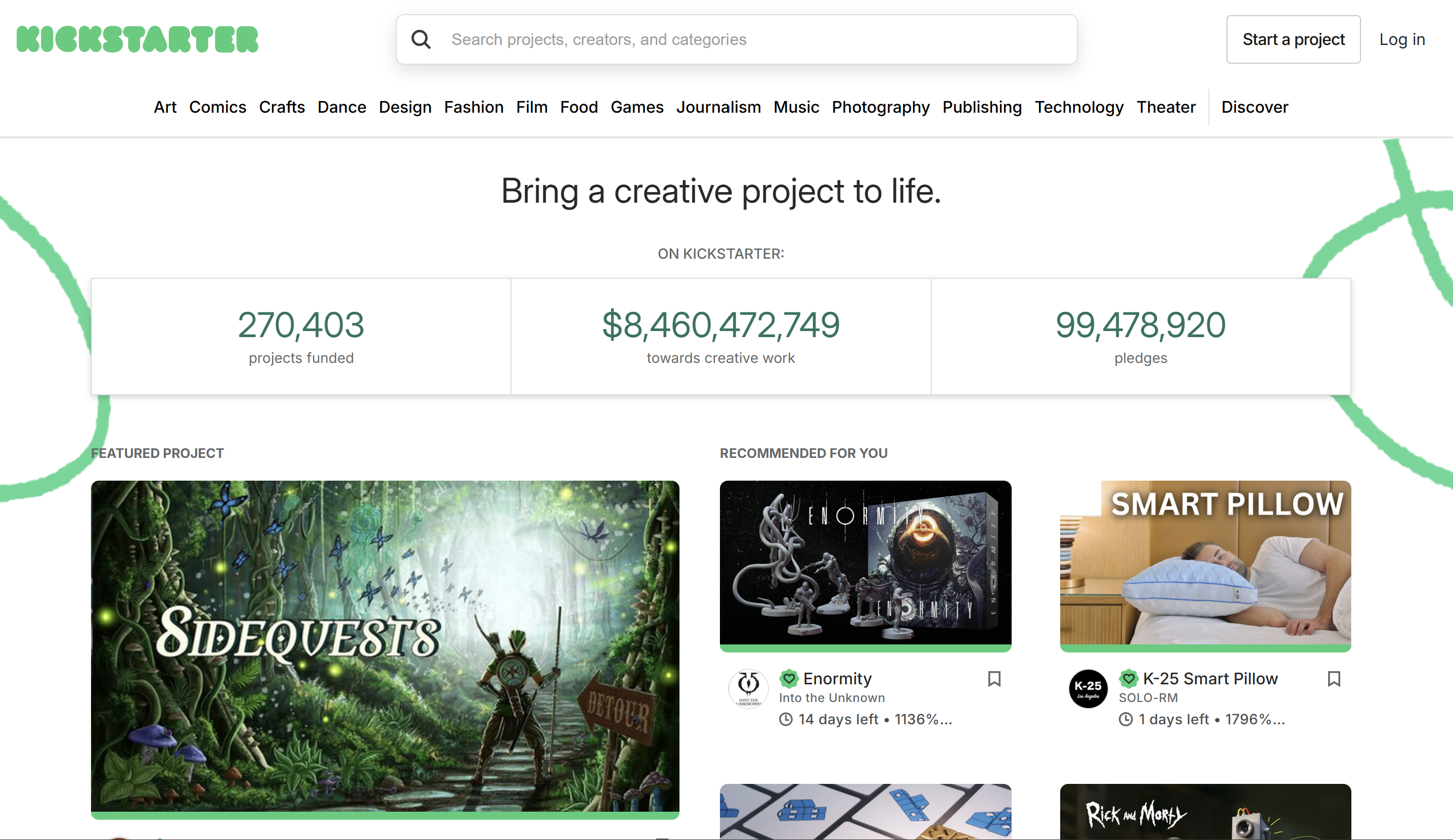
Kickstarter is the most famous, most popular and best-funded crowdfunding platform in the world. Crowdfunding is the old idea of fundraising, reworked for the internet age.
You raise small amounts of money from a large number of people. Together, it adds up to quite a sum. Kickstarter was founded in 2009. Since then, it has helped creators raise over $8 billion for all kinds of projects. Look on Kickstarter and you will see everything from tech gadgets to films, board games and beyond.
The idea is simple. Creators present their ideas, set a funding goal and invite backers to pledge support. What sets Kickstarter apart is its all-or-nothing model.
If you hit your goal, you receive the funds to bring your project to life. If not, no money changes hands. This pushes creators to make great campaigns. It also protects them from having to deliver on promises without the funds to do so.
New creators tend to think of Kickstarter mainly as a source of funding. To be fair, funding product creation is a great reason to use it. But many forget how the rest of the Kickstarter process helps with a product launch in a wider sense. That is what the next sections cover.
Is your Product a Fit for Kickstarter?
Kickstarter suits some products extremely well and others not at all. Work out which you are before you spend three months building a campaign.
What tends to work:
- A physical product. Something that exists, that can be held, filmed and shipped. The platform is built around making things.
- Something you can show in a short video. If the appeal is obvious within thirty seconds of watching, you are in good shape. If it needs explaining first, you are fighting the format.
- Something truly novel. Backers pay early and wait months. Part of what they are buying is the feeling of being early. A product with no novelty offers them nothing a store would not.
- A defined finished state. You can describe exactly what a backer receives and when. Open-ended projects with no clear deliverable struggle.
- A creator willing to be visible. A month of answering comments, posting updates and putting your face in the video. If nobody on the team wants that job, the campaign will feel absent, and backers notice.
What tends not to work:
- Services. There is nothing to ship and nothing to show.
- Software with nothing to look at. Apps in particular are a poor fit. The thing being funded cannot be photographed, and the backer reward is unclear.
- Commodity products competing on price. If your pitch is that it is cheaper, a marketplace does that better and right away.
- Anything where cheapness is the main appeal. Backers are not bargain hunters. They are early adopters, and a discount is not why they are there.
| Tends to work | Tends to struggle |
|---|---|
| A physical product you can show working. | A service, or software with nothing to look at. |
| Something novel enough that backing feels early. | A commodity item competing on price. |
| A clear finished state and a delivery date you can hold. | An open-ended project with no defined end. |
| A creator willing to be visible and answer comments daily. | A campaign run at arm’s length. |
| An audience you have already started building. | A launch to no list at all. |
If your product is not a fit, better to know now than after a failed campaign. Pre-orders through your own site, a marketplace launch, a distributor, small-batch production funded by revenue, or conventional financing all suit different products. None of them requires you to build an audience of strangers in ninety days.
8 Reasons to Use Kickstarter to Launch a Product
1. Kickstarter allows real-time market testing.
When you launch a product for the first time, the biggest risk is that no one will want to buy it. Business owners have all sorts of ways to try to rule this out. But the risk of launching a dud always looms. It keeps a lot of entrepreneurs up at night.
Kickstarter can remove some of that uncertainty. A campaign lets you see, in real time, whether people will spend money on your product. You do not have to start a full manufacturing run to find out.
When backers pledge their money, it signals real interest in what you offer. If no one bites, you have saved yourself the cost and hassle of producing something the market does not want.
Sure, you still have to make a prototype. You still need to build an audience for Kickstarter. You still spend time and money on your product. But you do not have to go all the way to full-scale manufacturing to know for sure if people will buy.
This is market validation at its finest. Unlike normal pre-orders on ecommerce platforms, Kickstarter campaigns thrive on visibility and urgency. Every backer becomes part of a feedback loop. You learn about demand, pricing, and even whether your product’s story lands.
Big brands spend millions testing products with focus groups and surveys. Kickstarter lets you reach the same goal without the overhead. When your campaign succeeds, you know your product has legs. You have also built an audience that is excited to see it come to life.
Pro tip
Treat the pre-launch page as the real test, not the campaign. The number of email signups you collect before you go live, and what each one costs you, tells you whether demand exists while you can still change the product. A campaign that launches to no list is not a market test. It is a bet.
2. Kickstarter lets you acquire backers before production.
Every business wants loyal customers. Kickstarter helps you earn them before you have produced a single unit. Backers do not just buy your product. They invest in you and your vision. They are emotionally attached, financially engaged and rooting for you to succeed.
This kind of engagement is rare outside Kickstarter. Time-limited campaigns tend to turn casual customers into brand advocates. They share your campaign, offer feedback and wait eagerly for your product. By the time production starts, you can already have a crowd of supporters ready to spread the word.
And here is the kicker. Their excitement builds momentum. Successful campaigns pull in more and more backers who only know about you because you launched on Kickstarter. Acquisition begets acquisition.
3. Kickstarter reduces financial risk.
Starting a business is expensive. Manufacturing, shipping and marketing costs add up fast. If the product does not sell, you are left holding the bag. Kickstarter removes this risk with its all-or-nothing funding model.
To recap how it works: you set a funding goal. If backers pledge enough to hit it, you get the money. If not, no funds change hands. You only have to produce something if the market is willing to pay for it. Backers only pay if enough of them exist in the first place. It is a clean system.
Failing on Kickstarter is not fun. But it is a lot easier and faster than failing after you produce a full run of products. You can sleep easier knowing your financial risk is far lower than it would otherwise be. And if you succeed, you know there is real demand, and you can prove it.
Where the financial risk actually sits
The claim that Kickstarter reduces financial risk is true in one specific, important way. It is misleading in several others. You probably arrived here because someone asked whether it is worth it, so here is the honest version.
All-or-nothing cuts both ways. If you miss your funding goal, no money changes hands. That protects you from having to deliver a product you cannot afford to make. It does not refund what you already spent getting there: the prototype, the video, the photography, the campaign page, the pre-launch advertising and the months of work. A failed campaign is not free. It just fails before the biggest costs rather than after them.
Fees come off the money you raise. Kickstarter charges a platform fee, and there are payment processing fees on top. Both come out before the funds reach you. They are published on Kickstarter’s own fees page, and they change. They need to be inside your funding goal, not a deduction you discover afterwards. Check the current schedule when you build your numbers.
Fulfillment and shipping are the classic overrun. Reward prices are set months before anybody knows the final weight, dimensions, packaging or mix of destinations. Then the product is heavier than the prototype. The carrier charges by size rather than weight. A real share of your backers are in countries where shipping, duty and tax cost more than you assumed. This is the most common way a funded campaign runs out of money. Know what fulfillment actually costs before you price a single reward.
The money is not free capital. Funds raised have tax and accounting consequences. The amount in your account includes money that belongs to production, shipping, fees and obligations you have already taken on. Treating a raise as revenue to spend is how creators end up short at the manufacturing stage. Talk to an accountant before the campaign, not after.
The obligation is delivery, and it is public. Backers are owed a finished product, not the option of a refund. If it is late, it is late in front of an audience. It is late in a comments section that anyone considering your next campaign will read. That visibility is an asset when things go well and a liability when they do not.
So the accurate version of the benefit is narrower than “reduces financial risk”, and still valuable: Kickstarter lets you find out whether people will pay for your product before you commit to a full production run. That is a real advantage. It is not the same thing as making the venture safe.
4. Kickstarter will help you connect with early adopters.
Every great product needs a champion. Kickstarter gives you access to a community of early adopters who love innovation and want to see creators succeed. They draw energy from being close to new ideas. These backers do not just buy. They believe. They are invested in your vision, and they want to see you bring it to life.
This is not a purely transactional relationship. Early adopters often become your most vocal advocates. They share your campaign and generate word of mouth. Their enthusiasm builds momentum during the campaign and lays the groundwork for long-term loyalty.
And here is the real value. These supporters are vocal about what they like and what they do not. They shoot straight. They give feedback that no focus group or survey can. They are emotionally tied to your success, and they want to see you win.
Pro tip
Export and keep your backer list, with locations, on the day the campaign closes. Where your backers cluster is the single most persuasive thing you can put in front of a regional retail buyer later. It is verifiable demand in their trade area, not a claim about your category.
5. Kickstarter campaigns are great for publicity.
A successful Kickstarter campaign is a magnet for attention. Journalists, bloggers and influencers often cover trending projects. That gives you organic media exposure that would otherwise cost thousands. Even before your product launches, you are building your brand’s reputation.
Media outlets love “media events.” Wikipedia defines the term as “an experience conducted for the purpose of creating media publicity”, as opposed to an event that unfolds on its own.
A media event is predictable. It fits their schedule, and it gives them something to write or talk about. They can plan their content calendars in advance, and their jobs get easier.
Kickstarter campaigns are great media events. They give you the perfect excuse to email reporters.
Kickstarter campaigns also thrive on social media. Backers love to share projects they support, which carries your reach far beyond your initial audience. That kind of viral potential is hard to match with traditional marketing alone.
The campaign ends and the media buzz fades. But when you make a play for ecommerce or retail, you already have articles, podcasts, videos, social posts and backlinks out there. That makes it simpler to move into a long-term distribution model or to launch future projects.
6. Kickstarter backers often have good advice on how to improve your product.
Some Kickstarter backers see themselves as customers. Others see themselves as collaborators. Many will offer valuable feedback on features, design or messaging that helps you refine your final product.
This feedback is not theoretical. It comes from people excited enough about your idea to fund it. They will point out details you missed, suggest improvements, and even share ideas for future versions. It is like having a focus group that pays you instead of the other way around.
Listening to your backers is not just good business. It is smart product development. And as the icing on the cake, when you act on their input, you build a better product. You also strengthen your bond with the very people who made the product possible.
7. Succeeding on Kickstarter builds your credibility.
Funding on Kickstarter puts money in your pocket, and that is a good thing in its own right. But a funded campaign is also a serious credibility boost.
Raising money from hundreds or thousands of backers shows investors, partners and future customers that your idea has real demand. It shows that you can set goals, run a plan and inspire confidence in others.
Credibility on Kickstarter extends to your operational skills too. Using the platform well takes clear communication, transparency and follow-through. When you meet those expectations, you signal to the business world that you can deliver results.
Then there is the final step. Handle the manufacturing, freight and fulfillment, and deliver on time and on budget. That proves you really are a capable business owner. Partners and distributors become more likely to want to work with you.
8. You can transition from Kickstarter to eCommerce and retail.
Many product developers see Kickstarter as the end goal. Savvier ones know it is just the beginning.
Many successful campaigns move smoothly to ecommerce platforms like Shopify, or into retail stores. Think long term and your well-run campaign does more than fund your product. It gives you the customer base, buzz and momentum you need to build a full brand.
Backers from your campaign often become your first customers on other sales channels too. They are invested in your product and eager to support its next stage. The assets you build on Kickstarter, like a strong mailing list and the social proof of a public success, let you launch an online store with a built-in audience.
Retailers also pay attention to Kickstarter. A funded campaign signals market demand, which makes it easier to win partnerships and shelf space. If retail is new to you, how products get on store shelves explains the steps. Our guide on how to get your product into Target shows what that step looks like at a national chain. In short, Kickstarter is an excellent springboard. Use it well and it can set you up for success in the wider market.
Note
Kickstarter suits some products far better than others. It rewards physical, visual and novel items that a short video can sell. It rarely works for services, for software with nothing to show, or for products whose main argument is a lower price. If yours is in the second group, the other funding routes are a better use of the same three months.
Pro tip
Work the full price chain before you publish a single pledge tier. Start from the shelf price the category supports. Take out the retailer’s margin to find your wholesale price. Take out your own margin to find your target cost. Only then decide what a backer pays. Doing it in the other order is how a funded product turns out to be unsellable at retail.
What your campaign price does to your retail price
Here is the piece of advice that only a retail consultancy will give you. It has to be acted on before the campaign launches, not after.
A Kickstarter campaign publishes your price, permanently. The campaign page stays up. Anyone can see what backers paid. That includes a retail buyer, and it includes the shopper standing in front of your product on a shelf. Now add the retail math. A retailer buys from you at wholesale and marks it up to a shelf price that leaves them their category margin. Say your backer price was set as a thank-you, with no reference to a viable shelf price. Then the product arrives at retail visibly more expensive than its own public history, and you have no good answer.
So build the ladder in the right order. Our guide to pricing your product for retail walks through each step in detail.
- Start at the shelf price your category supports. That is the input. The market sets it, not you.
- Work back through the retailer’s margin to your wholesale price.
- Work back through distribution, if a distributor is in the plan, to your price to them.
- Check it against your landed cost per unit at realistic production quantities.
- Then set the campaign price, at or above a level that will not undercut the shelf price you just worked out.
The backer price needs to feel like a deal, and it should. But make it a deal in a form that does not set a lower reference price for the same product. Early access. A limited edition finish or color. A bundle with an accessory. A lower tier with fewer components. Anything except the identical product for less money.
Three other things about the retail transition that campaigns rarely plan for:
A buyer will read your campaign page critically. They are asking whether the demand was real and broad, or concentrated among friends, colleagues and a single press hit. Backer count, geographic spread and the pattern of pledges over the campaign all tell that story. A buyer knows how to read it.
Backer fulfillment and retail fulfillment are different operations. Shipping single units to individuals is not the same as shipping cases to a distribution center. The packaging needs diverge completely. Retail packaging has to sell from a shelf, survive transit in a case, and carry barcodes and compliance marking. Decide whether retail is in the plan before the production run. Retail-ready packaging is a manufacturing decision, not a later tweak.
Your campaign is only evidence if you kept the data. Who backed you, where they are, what they chose, what they asked about, how many parcels arrived on time, and what your damage and return rate was. That record is what turns a successful campaign into a persuasive buyer meeting. It also helps with choosing the right retailer for your product, because it shows where your demand really is. Most creators never assemble it.
What to Have Ready Before the Campaign Ends
The gap between a funded campaign and a shipped product is where most public failures happen. Have all of this settled before the money lands, not after.
1. A manufacturer quoted at the real quantity, with a lead time in writing. Not a sample quote at a different volume. The real price and the real lead time for the quantity the campaign is likely to produce. Confirm it before you launch, so you can set a goal that covers it. The choice between overseas and domestic manufacturing changes both the price and the lead time.
2. A fulfillment plan and a shipping cost per destination band. Who picks, packs and ships, from where, and what it costs to reach each region you will accept backers from. If a region costs more than the reward price supports, decide that before the campaign page goes live, not afterwards.
3. Packaging that works for both jobs. A single unit shipped to a backer needs to survive a carrier. A retail case needs to survive a pallet and sell from a shelf. If retail is anywhere in your plan, design for both now. Doing it twice means a second production run.
4. Barcodes, if retail is anywhere in the plan. GS1 barcodes registered to your company, unique per variant, printed on the pack. Adding them later means new artwork, new printing and possibly new inventory.
5. A customer service plan for the month after shipping. Questions, damages, missing parcels, wrong addresses and setup problems all arrive at once. Decide who handles them and how, before they start.
6. Compliance and certification for your category. Testing, documentation and any marking required where you are shipping. This has a lead time, and it does not compress.
7. An update schedule you can keep. Through the entire period between funding and delivery, including the months where there is nothing good to report. Silence is what turns a delay into a crisis.
8. A record of who backed you and where they are. Names, locations, what they chose, what they asked, delivery performance and return rate. This is the item creators most often throw away once the parcels have shipped. It is also the one a retail buyer finds most convincing. Keep it.
Final Thoughts
Kickstarter is a great place to raise funds for products you want to make. You can test the market in real time and win your first customers, all while keeping financial risk low. And running a campaign is a solid way to build a community, earn publicity and build credibility.
Put all of these factors together and Kickstarter shows its true potential. Your goal does not have to stop at launching a single product. You can use Kickstarter to earn the funding, feedback and attention you need to set the stage for long-term success.
Free consultation
Talk to a retail expert about your product.
We build the retailer list, the pricing model, and the buyer pitch, so your first meeting starts from your numbers instead of theirs.
Retainer only, no commission · 150+ retailers · No obligation
Frequently asked questions
Three things, mainly. Funding is all-or-nothing, so missing the goal means collecting nothing after you have paid for the prototype, video and advertising. Fulfillment and shipping often cost more than the estimate you made before final weights were known. And the money raised is income with a delivery obligation attached, not free capital.
Funding is all-or-nothing, so a campaign either reaches its goal or collects nothing. A great many do not reach it. Kickstarter publishes its own current statistics, and that is where to look rather than at any third-party figure. The more useful question for a product brand is whether your pre-launch list is large enough to fund the goal on day one. Campaigns that start slowly rarely recover.
Kickstarter charges a platform fee plus payment processing on successfully funded projects. The rates change, so check Kickstarter’s current published fee schedule. Build the figure into your funding goal rather than treating the goal as money you will receive in full.
It can fund a first production run and prove demand, which is often what a new product business needs most. It does not replace the rest of a business. The delivery obligation to backers arrives whether or not the operations behind it are ready. So treat a funded campaign as a commitment, not a finish line.
Yes, and many brands do. But the campaign price has to be planned around it. Retailers need a margin on top of your wholesale price, and your backer price stays publicly visible. So set the shelf price first. Position the backer price as early access or a limited edition, not as the same product for less.