Advice
How SIOC Packaging Is Transforming E-Commerce and Driving Sustainability
The SIOC packaging requirements a package has to clear, how SIOC differs from SIPP, what failure costs, and how to design one pack for shelf and doorstep.
 Yohan Jacob
16 min read
World Packaging Design Day on May 7, 2025, put a spotlight on one of the biggest shifts in packaging today. The shift is toward packs that can ship on their own and waste less. Online shopping keeps growing. Brands are under pressure to cut waste, ship for less, and give customers a better experience.
One change leading the way is SIOC (Ships In Own Container) packaging. It is reshaping how products get to the door and how brands show up when the box is opened. Packaging is part of product development, so decide it as part of the work you do to validate your physical product idea. Below, we break down what SIOC is, the SIOC packaging requirements a pack has to meet, why it matters, and how Design Central helps brands get the most from it.
Key takeaways
- SIOC is a program with a test standard and a sign-off, not a general trend in packaging. The rules are published by the program owner.
- Ships in own container, ships in product packaging and ships in Amazon packaging are three different labels. Each one carries different duties and a different share of the risk.
- To pass, a pack has to survive transit tests, fit the size and weight limits, have no excess void, need no second box, and open with no tools.
- The business case is real, but it is a net figure. Redesign, testing and retesting come first, and the savings start once the pack has passed and keeps passing.
- Cutting damage in transit matters beyond the cost of a replacement. E-commerce returns generate nearly 24 million tons of CO2 a year (Davison, 2024).
- A shelf pack and a SIOC pack are opposite briefs. Decide at the design stage whether one structure can serve both channels, because fixing it after tooling costs a lot.
What Is SIOC Packaging?
SIOC, which many people also call SIPP (Ships in Product Packaging), is a pack built to ship straight to the customer with no extra box around it. There is no second shipping box. The product’s own pack is designed to protect it, carry the brand, waste less, and make opening it a pleasure.
Pro tip
Pull the current guidelines from the program owner before you brief a designer. Put the version date on the brief. These rules change, and pack projects run long. A brief written against last year’s document can produce a pack that fails the test for a reason nobody in the room knew about.
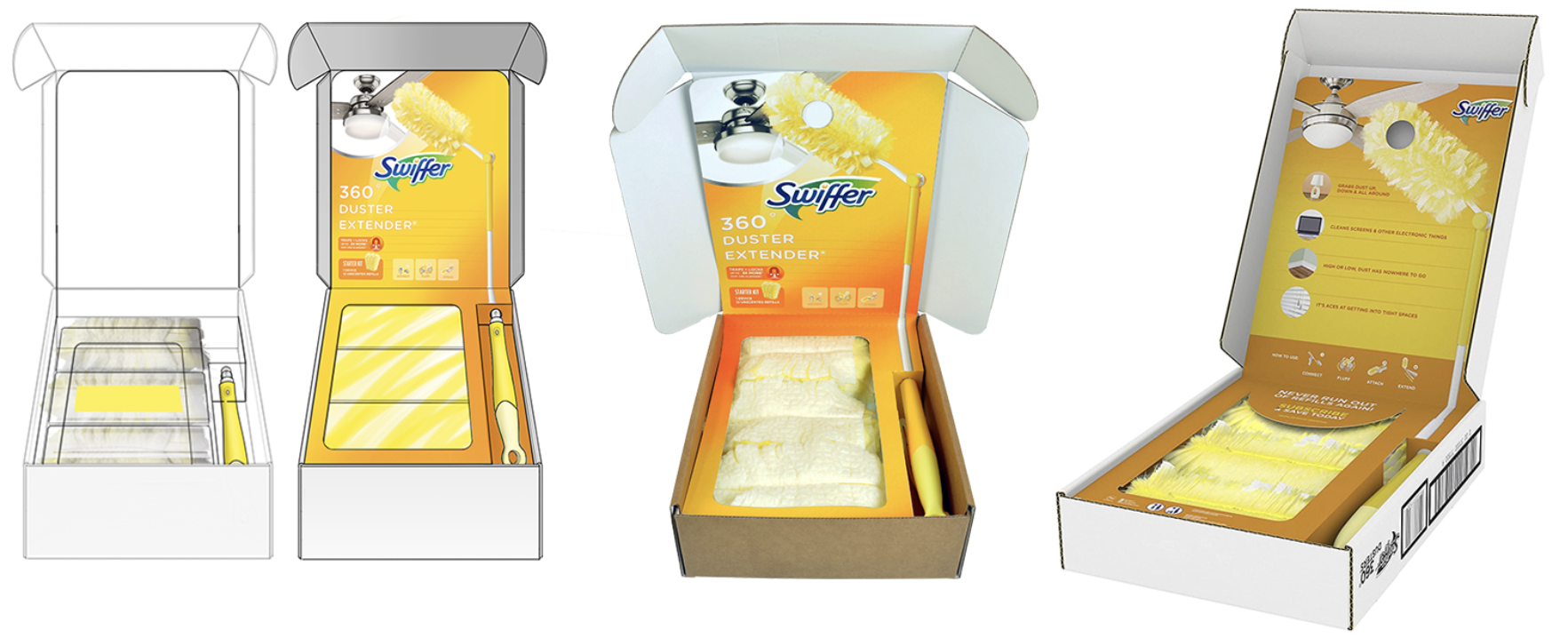
A strong example is the Swiffer Duster SIOC packaging Design Central created for Procter & Gamble. The pack is fully ready to ship online. It swaps plastic for cardboard that can be recycled, cuts waste, and makes opening it simple and fun. The structure is built to last the trip. It still carries bold branding that stands out online and in the hand.
SIOC, SIPP and ships in Amazon packaging are three different things
Three labels get used as if they mean the same thing. They do not, and the gap decides who pays for what. Here is the difference.
| Ships in Own Container (SIOC) | Ships in Product Packaging (SIPP) | Ships in Amazon Packaging | |
|---|---|---|---|
| What ships | The product’s own tested pack, with no outer box. | The product in the pack it already has, with nothing added to protect it. | The item placed inside a box from the warehouse. |
| Certification | Required, including transit tests. | Required, to the standard of the program. | None needed. |
| Who provides the outer box | Nobody. There is not one. | Nobody. There is not one. | The warehouse. |
| Branding on the outside | Your pack, seen by the customer at the door. | Your pack. | A plain box from the warehouse. |
| Contents visible from outside | Yes, unless the pack is made to hide them. | Yes, unless the pack is made to hide them. | No. |
| Who bears damage risk in transit | Your pack has to survive it. | Your pack has to survive it. | The outer box takes the hits. |
| Cost consequence | No outer box to pay for, but design and test costs. | Much the same, with the spec set by each program. | An outer box on every unit, and a bigger parcel to ship. |
| Non-compliance | Chargebacks, and you can lose the status. | Chargebacks, and you can lose the status. | Not applicable. |
The short version: ships in own container means your own pack has been tested and approved to travel alone. Ships in product packaging is the related label. It covers items that ship in the pack they already have, with nothing added to protect them. Ships in Amazon packaging is the default. It means somebody puts a box around your box.
The difference is not cosmetic. It decides who supplies and pays for the outer box. It decides whose pack is liable when a product arrives damaged. It sets how the parcel is sized for the shipping bill. And it decides whether a chargeback applies when a unit misses the standard it was enrolled under. Which label to aim for depends on your product, your channel mix, and whether your pack can pass the transit tests with no outer box. Work that out before you commit to a redesign. The answer changes the whole brief.
Key Benefits of SIOC Packaging
1. Business Efficiency
SIOC cuts waste by removing shipping boxes and extra material you do not need. With fewer parts and lighter parcels, brands can lower:
- Packaging costs
- Shipping weight and parcel size
- Fulfillment and labor costs
Pro tip
Model the business case as a net figure over a full year, not as a saving per unit. Design work, tooling changes, sample builds and lab tests all land before the first outer box is saved. A project that looks obvious per unit can take a long time to pay back its setup cost at low volume.
This matters even more on Amazon.
Amazon’s Frustration-Free Packaging (FFP) program counts SIOC and SIPP as core parts. It rewards packs that can be recycled, open with ease, and prevent damage. FFP approval can lift how visible your product is and how it ranks on Amazon, and that can mean a real lift in sales.
What it costs when a package fails certification
The upside of this kind of pack is well known. The downside gets less attention. It is worth knowing before a project starts, because the cost climbs fast the later the failure shows up.
The cheapest failure is a pack that fails the test before launch. You pay for the redesign. You pay for a retest. The project slips. That is annoying, but it is contained. This is exactly why the test exists, and why it is worth doing early with a prototype rather than late with a full run behind it. Budget for at least one retest as a matter of course. First tries often need a tweak.
The middle case is a pack that passes the test and then fails in the field. Real shipping is rougher and more varied than any test protocol. A marginal design can pass a lab and still arrive damaged at a rate that hurts. Now you pay for replacements. You pay for return shipping. You eat the cost of the returned units. Worst of all, you collect bad reviews that describe damage rather than the product. Those reviews stay on the listing, and their cost is much harder to count than the freight.
The expensive case is a pack that is enrolled and then found to break the rules. Programs like this charge per unit for items that miss the standard they were enrolled under. Keep failing and you can lose the status for good. If that happens, the outer box comes back, and the parcel gets bigger and costs more to ship. The whole case for the redesign vanishes while you are still paying off the tooling that produced it. You may also be left with pack stock you can no longer use, which is its own exercise in liquidating excess inventory.
The fee structures, chargeback amounts and enrollment terms are set and published by the program owner. They change from time to time. Price the downside from the current published schedule for your category and tier before you commit, not from a number in an article. The point here is the shape of the risk, not the size of it. The cost of failing rises steeply the later you find out. That is the whole argument for testing a prototype properly and early.
2. Sustainability
Cutting extra packaging is one of the best ways a brand can shrink its footprint. Shoppers are more and more vocal about wasteful packs, above all when they shop online.
SIOC packaging supports sustainability by:
- Using less material
- Cutting plastic
- Making packs easier to recycle
- Supporting a circular economy
These gains help the planet. They also help brands meet rising rules from regulators and rising demands from customers.
Note
Sustainability is the easiest part of this story to write and the hardest to prove. Using less material is easy to measure. But the larger gain for the planet usually comes from fewer damaged units and fewer returns. That only shows up once the pack has been in the field long enough to produce real damage data. Treat early green claims as a direction of travel. Hold the firm claims until the return rate is in.
3. Enhanced User Experience
A pack does more than protect the product. It shapes how people see the brand. Thoughtful SIOC design improves the customer’s experience through:
- Unboxing that feels natural
- Clear product communication
- Branding that looks good and has a purpose
- Protection that prevents damage and returns
Pro tip
Hand a finished sample to someone who has never seen it and watch them open it without saying a word. Transit tests prove the pack survives the truck. They do not prove a customer can get the product out without a knife, and that moment is what ends up in the review.
A defining feature of SIOC packaging is its discreet exterior. It does not show what is inside, which helps cut porch theft. It also respects the customer’s privacy. That matters most for personal care items, gifts, or other sensitive buys that customers do not want on show at the door.
What a package has to clear before it qualifies as SIOC
Most coverage of this topic lists the advantages. The searcher usually wants the bar. Here is what a pack has to clear, by category, before it qualifies.
Structural performance under distribution testing. This is the central requirement. The pack has to survive a set series of drops, shakes, crushing loads and handling that mirror the route it will travel. It is tested to a recognized protocol and usually checked by an accredited third-party lab. The ISTA 6 series is the relevant family for this kind of program. A pack that has never been formally tested is not a candidate, however sturdy it feels in your hand.
Dimensional and weight limits for the tier you are targeting. Programs define tiers. Each one has its own size and weight limits. A product outside the limits for the tier you want is either not eligible, or it is eligible under a different tier with different rules. Check this first. It can end the project in five minutes and save you a test fee.
No excess void and no secondary overbox. The pack must protect the product with no second carton and no large pockets of empty space or filler. This is the rule that most often forces a new structure rather than a new material. A pack designed for a shelf tends to be larger than what is inside it, on purpose.
Openable without tools or excessive force. How the customer opens it is part of the standard, not a nice-to-have. Plastic clamshells, heavy glue, too much tape and packs that need scissors all count against you. The pack should open cleanly, in a clear order, without the customer wrestling with it.
Labeling and barcode placement that survives the route. Shipping labels need a flat, clean area of the right size, placed so they can still be scanned after handling. Barcodes need a spot that does not clash with the shipping label or get hidden by tape. Get this wrong and a pack that is sound in every other way still fails in use.
Material restrictions for some categories. Depending on the category and the tier, there may be limits on materials, on how easy the pack is to recycle, and on the use of certain plastics. These change over time and vary by region.
The exact thresholds, tier definitions, test protocols and material rules are published by the program owner and updated from time to time. Work from the current guidelines, not from any article, including this one. Have your packaging engineer or test lab confirm the version that applies before you commit to a design. Build this check into your product development strategies at the design stage, before tooling is ordered.
Designing one package for the shelf and the doorstep
For a brand that sells only online, a pack has one job. For a brand that also sells in stores, it has two, and they pull in opposite directions. This is the clash that quietly makes pack projects twice as expensive as planned.
| A shelf package wants | A shipping-ready package wants | |
|---|---|---|
| Size | To fill its planogram space and hold the eye. | The smallest structure that protects the product. |
| Void space | Fine, and sometimes on purpose. | Kept to a minimum, and part of the test. |
| Face | A big printed face, readable from several feet away. | Enough surface for a shipping label, and little else. |
| Structure | A hang hole, a stable base, or a shape that sells. | Whatever survives the drop and crush tests. |
| Theft deterrence | Often made larger than the product on purpose. | Not relevant, and works against a pass. |
| Openability | Secure enough to resist tampering in store. | Easy to open with no tools. |
| Contents visible | Often a selling point, through a window or clear pack. | Often better hidden, for privacy at the door. |
| Outer carton | A separate shipper for case quantities. | None. The pack is the shipper. |
Read the two columns and the clash is obvious. Almost every instinct that makes a pack work on a shelf makes it harder to pass as a shipper. Almost every saving that makes it pass as a shipper weakens it on a shelf.
The fix is a decision, made at the design stage, about which of three routes you are taking. One structure that serves both channels, with trade-offs on each. Two structures, a shelf pack and a ship-ready pack, with two sets of tooling, two sets of artwork and two SKUs to manage. Or one structure plus a variant, where a shared base pack takes a different outer finish or insert depending on the channel.
What decides it is your category, your unit economics and, more than anything, how your volume splits between the channels. A brand that sells mostly online should design for the shipper and accept a weaker shelf presence. A brand that is mostly retail should design for the shelf and accept an outer box online. A truly split brand usually ends up running two. Budget for it honestly rather than finding out later.
Make this call before tooling. The expensive version of this project is the one where a pack is designed for one channel, tooled, and launched. Then a retailer asks for a shelf-ready version, or the online team asks why every unit ships in an outer box. If you are building relationships with retailers, expect that ask. At that point the decision costs a second tooling bill. It was a conversation that could have happened for free at the design brief.
How Design Central Helps Brands Succeed With SIOC Packaging
Moving to SIOC is not a simple swap. It takes smart design, engineering, testing, and insight into how people use the pack. Design Central brings decades of packaging know-how to make sure every SIOC pack performs in the real world of online orders.
Operational Efficiency
SIOC can be hard for products that are oddly shaped, fragile, or prone to leaks. Design Central’s team brings deep knowledge in:
- Material performance
- Structural engineering
- Distribution testing
- Logistics and fulfillment requirements
Pro tip
Ask your retail buyers for their shelf and case pack rules before you finalize a SIOC structure, even if retail is a small share of volume today. Retooling a tested shipper to fit a planogram costs more than designing for both at the start. The buyer conversation usually arrives after the online pack is already in production.
Their approach reduces damage and returns. That matters, because e-commerce returns generate nearly 24 million tons of CO₂ annually (Davison, 2024).
They also make sure a pack meets all ECR (E-commerce Ready) requirements, which avoids costly exclusions and delays.
Sustainability Expertise
Design Central helps brands cut or remove plastic, explore other materials, and make packs easier to recycle. They do it while holding cost, safety, and brand identity.
Their hands-on commitment to sustainability includes:
- Touring recycling plants to see how recycling really works
- Researching best practice in the circular economy
- Studying new materials, new ways to manufacture, and paper-folding techniques
- Taking part in thought-leadership events to stay ahead of industry standards
User Experience-Driven Design
A good pack must work for the user at every step, from opening to reuse to disposal. Design Central designs packs with:
- Opening sequences that feel natural
- Exceptional product protection
- Clear messages and instructions
- A polished look that reinforces the brand
High-fidelity prototypes are tested with real shoppers. That lets brands confirm design choices before they launch.
Quick check
Want help getting your product into retail?
Ready to bring your product into major retailers but need help with the process? Retailbound can guide you every step of the way. Book a free consultation with one of our retail experts. We’ll show you how to get retail-ready, meet the right buyers, and grow in retail for the long term.
About Design Central
This guest post comes from Design Central, a full-service product development firm that focuses on:
- Research & strategy
- Product design & engineering
- Prototyping
- Packaging design
- UX/UI
Design Central partners with brands to create packs that protect the product, work hard, and get remembered. Whether you are launching a new product or revisiting an existing line, their team can help turn packaging into an edge.
Ready to explore your next packaging design? Connect with Design Central on their website: Design Central.
Free consultation
Talk to a retail expert about your product.
We build the retailer list, the pricing model, and the buyer pitch, so your first meeting starts from your numbers instead of theirs.
Retainer only, no commission · 150+ retailers · No obligation
Frequently asked questions
SIOC stands for ships in own container. It means the product’s own pack is strong enough and compliant enough to ship to a customer with no separate box. It has passed the test for that standard, not just been assumed to meet it.
SIPP stands for ships in product packaging. It is the related label for items that ship in the pack they already have, with nothing added to protect them. It is easy to confuse with SIOC. The practical difference is in which rules and tests apply to your category.
It means the item goes to the customer in the pack it already has. No extra box or filler is added at the warehouse. For the brand, the shelf pack is now the shipping pack. It has to survive the trip and open cleanly at the other end.
It is the default. The item is placed inside a warehouse box before it ships. The brand carries no extra test burden. It also gets none of the savings on material, and the customer gets a box inside a box.
It is a fee applied when a pack enrolled as ships in own container is found not to meet the program rules. Fee structures are published by the program owner and change. Price the risk from the current schedule, not from a figure in an article. The more expensive outcome is usually losing the status, because the outer box and its cost come back.
It can, but not on its own. A shelf pack and a tested shipper are designed to different briefs. A brand selling in both channels has to decide whether one structure serves both or whether it runs two. That decision belongs at the design stage, because fixing it after tooling means paying twice.