Getting your product into Costco can be a significant growth opportunity for manufacturers and consumer brands looking to expand beyond ecommerce and direct-to-consumer sales. Costco gives the right brands access to a large membership base and a high-volume retail channel, while also providing valuable retail credibility and exposure. For products that offer strong value, meaningful differentiation, and a clear fit with Costco’s customer base, becoming a Costco supplier can be an important step toward scaling your brand.
However, getting your product approved by Costco is highly competitive. Having a great product is only the starting point. Costco buyers look for products that offer compelling value to their members and fit the retailer’s assortment, while suppliers must be prepared with competitive pricing and margins, retail-ready packaging, reliable inventory and fulfillment, and the operational capabilities to support a large retail program. Your sales history, marketing support, product presentation, and ability to clearly demonstrate why your product belongs in Costco’s assortment can all influence the buying decision.
Key Takeaways
- Costco carries a deliberately narrow assortment, so a yes usually displaces an existing item rather than adding to the shelf. Your pitch has to name what you replace.
- Club pack sizing is not packaging work, it is an economics decision. It changes your production run, your landed cost and your minimum viable order before you talk to anyone.
- Member value is the test. Every proposal has to answer what a Costco member gains at that price, measured against what is already on the shelf, including Kirkland Signature.
- Compliance and EDI are where the money leaks. Requirements around the supplier agreement, barcoding, routing and on-time delivery generate deductions after you are shipping, not before.
- Most first Costco relationships are small. Road shows, regional tests and Costco.com listings are the normal way in, not a consolation prize.
- A general vendor inquiry is the weakest route available. Reaching the buyer for your specific category, through a broker, a distributor or an introduction, is what moves a submission.
Thinking About Selling Your Product Through Costco?
Let’s discuss your product, pricing and retail strategy.
How to Become a Vendor at Costco
Costco’s reputation for offering quality products at unbeatable prices is well-earned. But what exactly does it take to get your product onto their shelves? Understanding their selection criteria is the first step. Costco looks for products that stand out in terms of quality, innovation, and price competitiveness. They have a keen eye for products that add value to their members’ shopping experience.
While the process may seem daunting, it’s important to remember that Costco values uniqueness. They seek products that offer something different, whether it’s a new twist on a classic item or an innovative solution to a common problem. To succeed, manufacturers must be ready to showcase how their product aligns with these values.
Research is key. Understanding past successful products and keeping an eye on emerging trends can provide valuable insights into what Costco is looking for. By aligning your product with Costco’s selection criteria, you’re already one step closer to success. Once you have aligned your product with Costco’s selection criteria, you can reach out to them directly at their corporate office.
Two different people search this topic with almost the same words. A brand wants Costco to stock its product. A member wants Costco to carry something they like. This guide is for the first. If you are a member suggesting a product, Costco handles that through its member service channels, which is a different route entirely.
Why Costco Buys Differently from Every Other Big-Box Retailer
Brands pitch Costco the way they pitch everyone else and are rejected before the product is really considered. The reason is not the product. It is that Costco’s buying model is different in ways that change what a good submission even looks like.
Start with assortment. Costco deliberately carries a narrow range in each category, far narrower than a conventional big-box retailer. That is the model, not an accident, and it has a direct consequence for you: a yes usually means something else comes off. You are not asking for a gap to be filled, you are asking a buyer to displace an item that is currently earning its place. If your pitch does not have an answer to what you replace and why the member is better off, it is incomplete.
Then the pack. Costco sells in club pack sizes, which is not a packaging tweak. It changes your unit economics, your minimum production quantity, your case configuration, your freight and often your tooling. A product that works beautifully as a single unit can be unviable as a multipack, and that arithmetic has to be done before the meeting rather than during it.
| Costco | Traditional big-box | |
| Assortment per category | Deliberately narrow | Broad, many facings per subcategory |
| What a yes usually means | Something else comes off the shelf | Your item is added to the range |
| Pack format | Club pack, multi-unit | Single retail unit |
| Who you must satisfy | The member, on value | The category, on margin and turn |
| Private label in category | Kirkland Signature, a direct benchmark | Store brand, usually lower tier |
| Typical first order | Often regional, a road show or a test | Often a category-wide rollout |
Two more features of the model are worth understanding. The treasure hunt element means some items appear for a season or a single buy rather than holding a permanent slot, so a limited run is a normal outcome rather than a rejection. And Kirkland Signature exists across many categories as both a quality benchmark and a direct competitor, which means your value argument is being measured against an own brand with scale advantages you do not have.
Everything else in this guide follows from that. The value equation has to be obvious, the pack has to be right, and the answer to what comes off the shelf has to be yours rather than the buyer’s to work out.
Preparing Your Product for Costco
Before approaching Costco, it’s crucial to ensure your product is up to their high standards. This involves everything from packaging design to pricing strategy. Your product’s packaging should not only be appealing but also practical and durable, as it will need to withstand the hustle and bustle of a busy warehouse environment.
Pricing is another major factor. It must be competitive yet profitable. Costco shoppers expect great value, so finding that sweet spot is essential. Conducting market research to understand price points for similar products can provide guidance.
Quality cannot be compromised. Ensure your product meets or exceeds industry standards. Consider getting certifications or endorsements that can bolster your product’s credibility. Remember, a product that consistently delivers quality is more likely to win Costco’s favor.
Pro Tip: Build and cost the club pack before you write a word of the proposal. Work out what a multi-unit pack does to your carton dimensions, your pallet configuration and your production run length, then recalculate landed cost from there. Brands routinely pitch a single-unit product and discover at the negotiation that the club pack costs more per unit to make, not less.
Building a Strong Proposal
Once your product is ready, crafting a compelling proposal is your next task. Your proposal should clearly outline your product’s unique selling points and its potential for success in Costco’s environment. Highlight how your product aligns with Costco’s values, such as quality, innovation, and value for money.
An effective proposal goes beyond just presenting facts. It tells a story. Share the inspiration behind your product and its success in other retail settings, if applicable. Use data as well as past customer reviews to back up your claims and provide projections for future success.
Don’t forget the visual aspect. A well-designed presentation with clear visuals can make a significant impact. It should be easy to digest and highlight the key points that make your product stand out.
Pro Tip: Write the member value sentence first and build the proposal around it. It should read as what a member gets, at what price, compared with what they buy today. If that sentence needs a paragraph of context to land, the buyer will not reach the context.
Why Costco Turns Down Products That Are a Good Fit
Plenty of products that would genuinely sell at Costco do not get in, and the reasons usually have nothing to do with quality. These are the ones that come up repeatedly.
The club pack breaks the economics. The product works as a single unit and falls apart as a multipack. Either the unit cost at the required quantity leaves no margin, or the pack becomes too large or too expensive for the value threshold, or the minimum production run to make it viable is beyond what the brand can fund. The buyer sees a price that does not clear the member value test and moves on.
The brand cannot fund or fulfill the order. A warehouse-level order is a large quantity arriving at once, paid for by you long before you are paid. Add the compliance infrastructure, the freight and the safety stock for a reorder, and the working capital requirement is substantial. A brand that cannot demonstrate it can supply reliably is a risk the buyer has no reason to take.
There is no answer to what this replaces. Because the assortment is narrow, the buyer has to take something out to put you in. A submission that positions the product as an addition to the category, without confronting the displacement, leaves the hardest part of the decision to the buyer. They will not do it for you.
The value equation does not clear. Costco members judge value against a high internal standard, and often against Kirkland Signature sitting in the same category. Being good is not enough. The buyer is asking whether a member picking this up will feel it is obviously better value than the alternative already on the floor, and the answer has to be visible at a glance rather than explained in a deck.
The submission went the wrong way. A general vendor inquiry is not the same as reaching the buyer responsible for your category, and it is the route where most submissions quietly stop. Understanding which channel is appropriate for your situation, and what each one is for, matters as much as the pitch itself.
A partial yes was treated as a rejection. An offer of a road show, a single region or an online listing is not a consolation prize. It is how most brands actually start, and it is the buyer reducing their risk while giving you the chance to prove sell-through. Brands that hold out for a national order rather than take the smaller opening frequently end up with nothing.
Navigating the Presentation and Negotiation
Having secured an opportunity to present your product, the next challenge is engaging with Costco buyers. This step requires a mix of preparation, confidence, and flexibility. Start by understanding the audience – the Costco buyers. They are seasoned professionals who appreciate thorough research and clear, concise presentations.
During negotiations, focus on the value your product brings to Costco and its members. Be transparent about your pricing, production capabilities, and any limitations. Flexibility is crucial, so be ready to discuss different terms and packaging options.
Remember to listen. Buyer feedback is invaluable and can help refine your offering. Approach negotiations with an open mind and a willingness to adapt. This approach shows cooperation, a quality highly valued by Costco.
Pro Tip: Come to the meeting with your capacity answer already written down, including your co-packer’s lead time and your ceiling. The question that ends most Costco conversations is not about price, it is whether you can actually supply a warehouse-level order, and hesitating on it reads as a no.
Road Shows, Regional Tests and Other Ways In
Most guides present this as a single decision: national placement, yes or no. In practice a first relationship is usually something smaller, and a brand that does not know this reads a partial offer as a failure. These are the routes.
In-warehouse road shows and demos. A brand takes a temporary position inside the warehouse, staffed by its own people, selling directly to members over a set period. It proves sell-through in the real environment, in front of the actual customer, with data the buyer can see. What it costs you is stock, staff, travel and the coordination to run it well, and the requirements are specific enough that most brands use a road show company rather than doing it alone. It is the single most direct way to demonstrate that members will buy your product.
Regional or single-region placement. Rather than a national commitment, the item goes into the warehouses of one region. Costco limits its exposure and so do you: a smaller order to fund, fewer locations to supply, a manageable quantity to produce. It gives you a genuine sell-through record in a defined set of locations, which is exactly the evidence needed for a wider conversation later. What it costs is the slower build and the discipline not to over-produce against a hoped-for expansion.
Costco.com as a separate route. The online listing is its own decision with its own requirements, and fulfillment works differently from warehouse delivery. It can be a realistic entry point for products that do not suit a warehouse format, or where the pack size or price point works better online. Understand before committing that succeeding online does not automatically lead to warehouse placement, and that the operational demands are not the same.
Through a distributor or broker already in the category. Companies already selling into the category have the relationship, the compliance infrastructure and the understanding of the buying calendar that you do not. That costs you margin and a degree of control, and it can shorten the path considerably. Ask what they actually sell in, to which categories, and speak to another brand they represent before you commit.
The honest summary is that a small yes is the normal shape of a first Costco relationship. Take it, execute it properly, and let the numbers make the next argument for you.
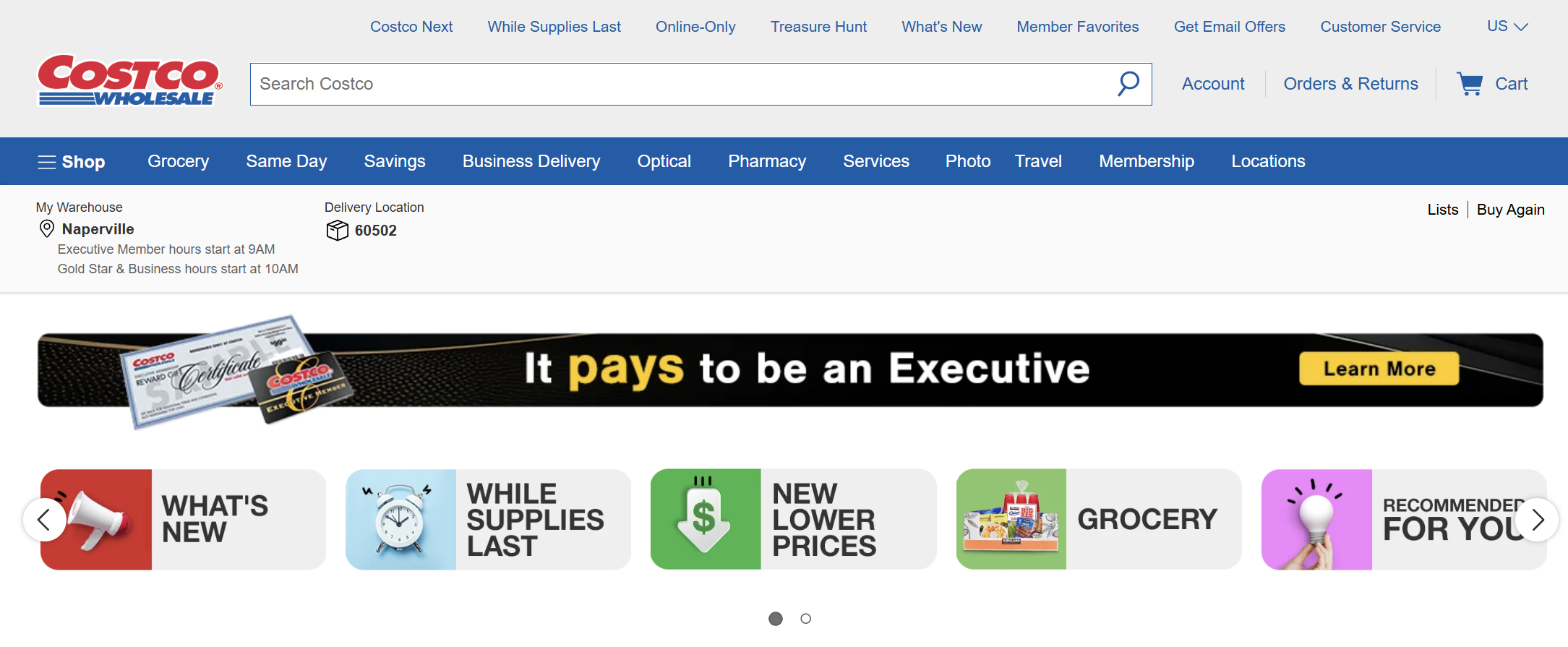
Costco Vendor Hub and Vendor Portal
The Costco Vendor Hub is a digital resource for approved Costco suppliers and vendors to manage various aspects of their business relationship with Costco. The portal can be used to access account and transaction information, review business documents and agreements, and conduct certain vendor-related activities electronically. Because access is intended for authorized Costco suppliers, product brands generally should not view the Vendor Hub as a general application portal for getting a new product into Costco.
Once you become an approved Costco supplier, the Vendor Hub and related vendor systems can become important tools for managing your Costco business. Depending on the vendor relationship and services available to the supplier, these systems may support activities such as reviewing account information, managing transactions, accessing business documents, and handling other operational requirements. Costco also maintains a separate Vendor Access Management system that allows vendors and suppliers to verify their email address and create or reset their portal password.
For brands that are still trying to get their product into Costco, the more important first step is to work through Costco’s vendor inquiry and merchandising process rather than trying to obtain Vendor Hub access. Costco provides prospective vendors with a Vendor Inquiries resource, while its Supplier Inclusion program provides an intake process for eligible businesses. Completing an intake or inquiry does not guarantee a Costco business relationship.
The vendor portal is where the relationship is administered, not where it begins. Logging in is something you do after a buyer relationship exists. If you are looking for portal access as a way to get noticed, you are in the wrong part of the process.
Costco Vendor Requirements, EDI and Compliance
Getting a yes from a buyer is the beginning of a second process, and it is the one that trips brands up. Compliance requirements are not negotiable, they are enforced automatically, and failures turn into deductions after you have already shipped. Here is how the requirements group.
| Area | What Costco expects | Where it bites if you get it wrong |
| Business | Entity details, insurance, signed supplier agreement | Application stalls before a buyer sees it |
| Product | Barcoding, club pack, labeling, category testing | Item setup is rejected at the portal |
| Systems | EDI capability and vendor portal use | Orders and invoices cannot be processed |
| Shipping | Routing, pallet and packaging specifications | Deductions against invoices after you ship |
| Fulfillment | On-time, in-full delivery at warehouse volumes | Performance penalties and a short relationship |
The EDI requirement is the one most first-time vendors underestimate. Purchase orders, advance ship notices and invoices flow electronically, and the setup involves your systems, a trading partner connection and a testing period before you can transact. It is not something to begin after you have an order. Establish whether your systems can do it, or whether you need a provider or a 3PL that already can, while you are still pitching.
What usually goes wrong is not a dramatic failure. It is a series of small ones: an advance ship notice sent late, a case label in the wrong position, a delivery that misses its appointment window, a certificate that expired without anyone noticing. Each carries a deduction, deductions come off money you have already earned, and they accumulate quietly until a brand discovers that a profitable order was not. Requirements and terms change, so work from Costco’s own current supplier documentation and the agreement you are given rather than from any third-party summary, including this one.
Post-Placement Strategies
Congratulations, your product made it to Costco’s shelves! But the work doesn’t stop here. Effective post-placement strategies are crucial for sustaining success. Start by implementing a robust marketing plan to drive awareness and sales. Consider in-store promotions, demos, and leveraging social media to reach a broader audience.
Inventory management is another key area. Costco’s high-volume environment means you must ensure a steady supply of your product. Collaborate closely with Costco’s team to stay informed about inventory levels and demand projections.
Customer feedback is gold. Pay attention to what shoppers say about your product and use this feedback to make improvements or adjustments. Engaging with customers can foster loyalty and turn them into brand advocates.
Pro Tip: Track your sell-through per warehouse per week from the first shipment, not per month in aggregate. Costco reviews items on their own performance and an average hides the regional pattern that would have told you which warehouses needed a demo before the review came around.
Taking the Leap into Costco’s Shelves
Getting your product placed at Costco is a significant achievement for any manufacturer. It requires thorough preparation, a compelling proposal, and effective negotiation skills. By understanding Costco’s selection process and aligning your product with their values, you can increase your chances of success.
Remember, the work doesn’t stop once your product is on the shelves. Post-placement strategies like marketing, inventory management, and customer engagement are crucial for sustaining success. Learn from the success stories of other manufacturers and take inspiration from their experiences.
If you’re ready to bring your product into major retailers but need help navigating the process, Retailbound can guide you every step of the way. Schedule a free consultation with one of our retail experts and discover how to get your product retail-ready, connect with the right buyers, and drive long-term retail growth.
Frequently Asked Questions
How do I get my products into Costco?
Reach the buyer for your specific category rather than submitting a general vendor inquiry, and bring a proposal built around member value, a costed club pack and a credible capacity answer. Most brands enter through something smaller than a national order, such as a road show, a regional test or a Costco.com listing.
How do I suggest a product to Costco?
Suggesting a product as a member and supplying one as a brand are different processes. Members raise suggestions through Costco’s member service channels. Brands go through the vendor route, which means a category buyer, a supplier agreement and compliance with Costco’s vendor requirements.
What are the vendor requirements for Costco?
Expect requirements across four areas. Business, covering entity details, insurance and the supplier agreement. Product, covering barcoding, club pack format, labeling and category testing. Systems, covering EDI and the vendor portal. And shipping, covering routing, pallet specifications and on-time delivery. Check Costco’s own supplier documentation for current terms.
How do I become a Costco vendor?
Becoming a vendor means clearing three things in order. A product that works as a club pack at a price a member can see the value in, a business that can meet the supplier agreement and compliance requirements, and a route to the buyer for that specific category rather than a general inquiry form.
How do I register as a supplier with Costco?
Registration runs through Costco’s vendor inquiry route and, once a buyer relationship exists, through the vendor portal where item setup and trading documents are handled. Registering is not the same as being reviewed. A submission still has to reach the right category buyer to go anywhere.
About the Author
Yohan Jacob is the President and Founder of Retailbound. Retailbound is a comprehensive retail channel management consultancy that helps brands launch and scale their products in over 150+ retailers in both the US and Canada. Specializing in bridging the gap between product creators and retailers, Retailbound offers a range of services from retail strategy development, buyer engagement, sales management and channel marketing support. Whether the client is a startup or an established brand, Retailbound provides expert guidance to increase their retail presence, navigate buyer relationships, and drive sales growth both in-store and online.